S3 E10: Inside Stall 13 with AP Graham: Helping the OTTBs Who Fall Through the Cracks
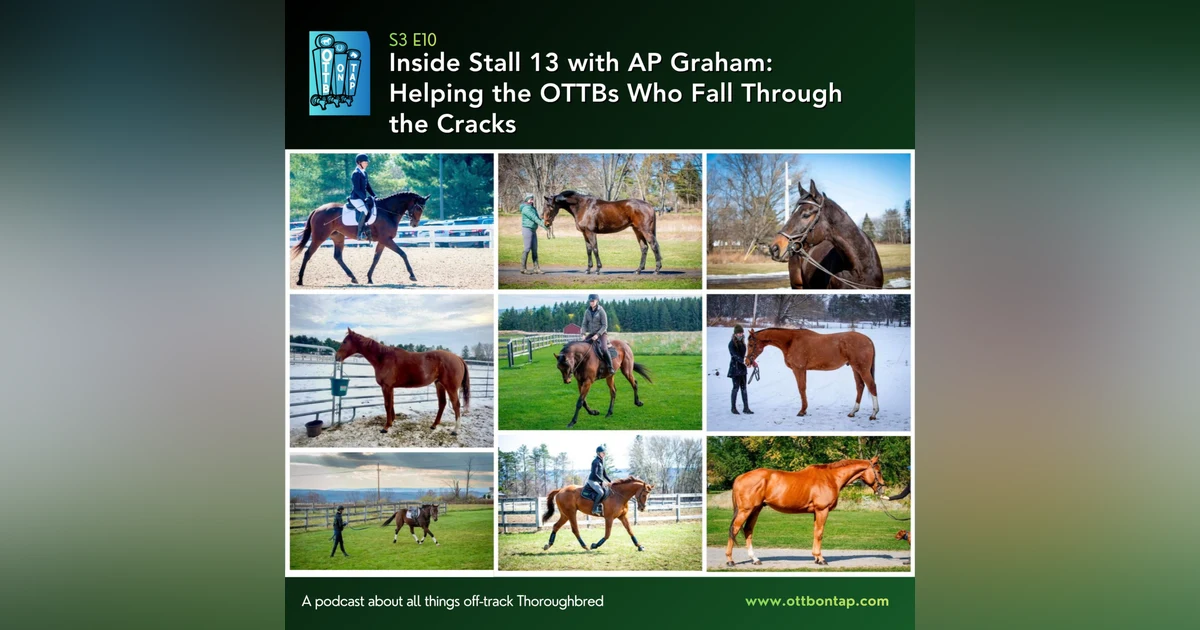


Fan-favorite guest Aubrey “AP” Graham returns to OTTB on Tap to take us inside Stall 13, her new nonprofit created to help a particularly vulnerable group of off-track Thoroughbreds: the horses who encounter complications during their transition or later in their second careers and may otherwise fall through the cracks.
Many OTTBs move successfully from racing into new homes and careers, often with the support of excellent aftercare and retraining programs. But some need more time, investigation, rehabilitation, or specialized support than a traditional transition allows. These may be horses dealing with unresolved pain, unsuitable placements, training challenges, or owners who no longer have the resources to help them move forward.
Aubrey explains how Stall 13 works alongside her training and sales program, Kivu Sport Horses, to give these horses time, thoughtful evaluation, veterinary support, retraining, and a better chance of finding the right long-term home.
The conversation dives deeply into the connection between pain and behavior in off-track Thoroughbreds. Aubrey shares real-world cases involving kissing spine, hock arthritis, suspensory injuries, ulcers, hoof pain, rearing, bucking, rushing, and spooking. She explains why the most obvious diagnosis is not always the correct one, and why riders may need to look beyond the back and begin with the horse’s feet, lower limbs, and hind end.
Emily, Niamh, and Aubrey also discuss the challenges of honestly marketing Thoroughbreds, the limitations of describing any horse as “safe,” and why a horse may behave very differently after moving to a new barn or rider. They explore what adult amateur riders are really asking for when they want a quiet trail horse, and why that type of experience and reliability can take significant time and training to develop.
Aubrey also shares updates from Kivu Sport Horses and Thoroughbred Logic, including her upcoming Thoroughbred Logic book. Designed as a practical guide to understanding and retraining off-track Thoroughbreds, the book connects what horses learn at the racetrack with their behavior, training, physical needs, and first rides in a second career.
This episode is an honest, thoughtful look at OTTB rehabilitation, horse-first training, pain-related behavior, responsible placement, and the difficult but rewarding process of figuring out what each individual Thoroughbred needs to succeed.
Connect with Aubrey Graham and Kivu Sport Horses
Website: www.kivusporthorses.com
Facebook: AP Graham
Facebook page: Kivu Sporthorses
Learn more about Stall 13
Website: www.stall13.org Substack: https://substack.com/@stall13thoroughbreds
The Stall 13 website also includes information about the organization, available horses, and ways to donate.
Off-Track Talk: Stall 13 Deep Dive
Niamh: [00:00:00] Hi, everyone, and welcome back to OTTB On Tap. I'm Nieve
Emily: And I'm Emily. Hey, Niamh, what's on tap today?
Niamh: Our guest today is fan favorite Aubrey Graham, founder of Kivu Sport Horses and creator of Thoroughbred Logic, a popular educational platform dedicated to helping riders better understand and retrain off-the-track Thoroughbreds. With a background as a cultural anthropologist and more than 20 years of professional training experience, Aubrey has earned a reputation for her thoughtful horse-first approach to training. Through her writing, clinics, and educational programs, she's helped countless riders better understand the minds of Thoroughbreds and build stronger partnerships with them. Today, we're catching up on everything she's been working on, including her new organization, Stable 13. We'll take a deeper look into her series, Thoroughbred Logic, and what's next for both her and Kivu Sport Horses. Thank you so much for joining us.
Aubrey: Thank you for having me. And just if we need to redo, [00:01:00] it is stall 13. Not that it matters that much, but...
Niamh: sorry. Stall 13.
Aubrey: okay. They got it. It's all the same. It's just a box we put them in and it's all absolutely great
Niamh: website all day today. How did... i'm in menopause. I blame menopause.
Aubrey: So am I. It's fun. It's very complicated. It's all good. You're good.
Emily: That's fine.
Niamh: Okay
Aubrey: But also, can I steal that introduction for days I'm, like, having crappy days so I can just play that and be like, "Wow, thank you"?
Niamh: I'll send it
Aubrey: that's awesome.
Niamh: a clip and you can just put it on repeat.
Aubrey: That's amazing. But thank you so much for having me, guys. This is great. I'm really thrilled to be back. You're my favorite people to talk to on a podcast
Emily: Last time we talked about how y- how you train horses, and since then it feels like your work has expanded beyond just training individual horses. You're building communities, educational resources, and now Stall 13. almost feels like your philosophy has become an [00:02:00] organization. For listeners who haven't heard about Stall 13 yet, what is it?
Aubrey: Stall 13 is a nonprofit. We're a 501[c][3] based in New York, and it's... We're a small nonprofit. We have five horses currently maybe six if we count the one that's leased out. And we basically are a little bit of a boutique, not aftercare organization. I really hate the word aftercare. We can get into that at some point.
But what we do is take horses who are having a tough time off the track, and they can be the ones coming straight off the track with sometimes with rehabs. We had one with a really horrific knee. Things where people say, that's not a case I wanna take a risk on," we'll take that risk. And we deal with, I have...
So I have one that had a huge suspensory issue. We've had one with a knee coming off the track. And then the other, and I think the part that I find more interesting about this, besides just the general rehabs, which I learn a lot. I think they're really neat. I'm getting a lot of extra veterinary knowledge [00:03:00] understanding how to go forward with these things.
But the other part of it is we come in on two streams, is also working with horses who are midway in some way, shape, or form of their second career. And I find that those horses tend to often be seriously at risk because there aren't necessarily the aftercare organizations or the rescues that are able to work with them and help them in certain ways.
So you have horses right off the track. There's actually quite a bit of good aftercare out there. There's lovely organizations that take these horses, do the rehab. I could name drop a handful, but they're wonderful, and they're already doing that. So us doing that is it's great.
I like doing that. It's fun. It's probably needed, but it's not the most important thing out there. What I find happens is when you have horses that get themselves in through a series of whether it's injuries inappropriate, I say inappropriate, but I don't blame the people, right? Sometimes it's just the situation.
But inappropriate housing, turnout, care, feed management lack of, veterinary knowledge, things like this. They get stuck, and then you have this seven-year-old horse who's been off the track for four [00:04:00] years and is worth less than they were when they came off the track. The owners don't have any more money to put into them, and they're at risk.
So we have some interesting horses that come through, and those are the cases I really love. I've been doing those cases for years. And so basically in short, Stall 13 is this two-channel program where we take horses from the track and do rehabs, but we also work with challenging case Thoroughbreds that come from their second careers who just need, to be cliché, to get on a better path, right?
Or get back on a better track, if you wanna say it that way. But They need to p- hit pause for a second, get ana- a- anthropologists. So we need to analyze, I need to analyze what's going on, figure the horse out, make a plan for how to go forward, and then get them to a next home, right?
So the idea is that they don't stay here with us. We're not a sanctuary. They could stay as long as they want. I don't flip these horses. They don't come in and leave quickly, like at all. Sometimes much to everybody's chagrin, they're here for quite a long time. But then we get them to a spot where they hopefully can have a long-term home, and [00:05:00] with a guarantee that they can always come back.
Now, I have that guarantee with any of my horses that sell out of my program anyway, because the thing that lets me sleep at night is knowing that if these horses get in a bad spot, suddenly hate the new trainer or the new barn or the new stalls, which all of which I've had happen and the person goes, "I don't have the resources or the ability or the desire to work with this anymore.
Can you just take it back?" The answer is always yes. Or I can reconcile it for them. So those horses can always come back anyway. But Spell 13 comes with a little bit more robust when it sells, you kinda have to pass a contract along and things like this. So sorry, that's a kind of a long, rambly way to say we take horses and rehab them off the track, and we also run this, challenging case program for horses that are coming through their second careers.
Niamh: Yeah
Emily: that's really brilliant though, because there's so ... Sorry, Neve. There's just, like you said, so many resellers or aftercare programs, and I feel like the Thoroughbred, there was this kind of rebirth of interest in the off-track Thoroughbred through the RRP and [00:06:00] of these other programs. Plus they are the more economical horse to get into in a lot of ways, and I think that while it's great that it encourages a lot of people to get into off-track Thoroughbreds, sometimes they're not quite ready for one that's fresh off the track, and then what do you do? So it's wonderful that you guys are, that you are providing this really soft landing for them.
Niamh: Yeah.
Emily: really
Niamh: That's
Emily: question. I just think it's
Niamh: not really a question. No, it's a nice follow-up though. I was also gonna say that if you wanted a little bit of insight into how thoughtful this program is, all you have to do is go look at the available horses listed on Stall 13's website, because way that these horses are described, it's not so much a sales ad as it is a LinkedIn profile with a little Tinder mixed in. It's just this it's this what I could be good at, what my personality's like, how I look, [00:07:00] where I would thrive. The type of person I'm looking for will be X, Y, and Z, and it's gosh, it just covers, like, all of the bases so that... And I love the fact that you go, "And if you're not somebody who wants to do this, I'm sure we have another horse you might like." And it's just very, it's honest, but it's not off-putting. And I think that the the resale industry is lacking a little bit of that finesse sometimes. I think, especially when you're, like, a high volume reseller, you've gotta just stop people in their tracks a lotta times, like, 'cause you just don't have the time, right?
But it's so cool that you guys have this secondary portion of your program where you get to take that extra time and really think about process in a way that means the horses are never in a rush to leave. So
Aubrey: And I should probably explain the way it's linked to my for-profit, because that gets a little confusing, right? 'Cause you have Keep Us Four Horses, which is the for-profit program, which is my full-time job. And the nonprofit side [00:08:00] of this is basically I've been taking these cases for years and just losing money on them.
This is just what I do. I'm a very poor business person when it comes to things. People are like, "You should get that horse out the door." And I was like, "We're gonna fix it." And they're like, "Oh, God. Okay." Year and a half, year and a half later, I'm like, "We're going beginner novice. It's getting fixed."
But so I've been doing that anyway, but the for-profit side I take in consignment, so I get a lot of interesting horses that come in as well that are maybe not perfect, and I also like imperfect horses. I joke that they're my Island of Misfit Toys or we're the Island of Misfit Toys, and my horses are all my misfit toys, right?
There's... You keep a Thoroughbred around long enough, you will start to figure out all the things that might not be perfect about them, and some of them, sure I have yet to meet a perfect one. But I'm sure they might be out there. But the for-profit ones are, we're able to get them to regular riding homes, more competitive homes, things like this, and When they stru-- sometimes when they struggle in those situations or we start finding all of these things that are like, "Oh, [00:09:00] wow.
Oh, no." Maybe we can't just move this horse to a home, a norm- like in a normal fashion to a normal home. Sometimes they can move from that program to the nonprofit.
For instance, I have a horse named Hennessey. He has a great jockey club name, he's Johnny Bootlegs, and he's this gor- he's this gorgeous, like bright chestnut/liver chestnut, 16.3 hands, seven-year-old, and I love him.
But he came in, he's got some hind end stuff, and I disclose it in ads. But how do you sell a horse? What do you say? We have some hind end stuff, but I don't know what it is."
Niamh: Right.
Aubrey: the owner was like-- she was wonderful, and she was like, "I want him to be there. I love the training, but I can't afford a workup with your vet and any di-
Niamh: a workout with your vet."
Aubrey: Real diagnostics."
And I was like, "Okay, but we can't sell the horse until we have the workup, and we're not gonna get someone to pay for that on a PPE because this horse is just too much of a risk." Watch him go, he's like, it is not a question. It's not oh, so I'm like, "Let's take him out and do some photo shoots in the field," and be like, "He might be able to do a walk, trot home, but really you [00:10:00] still have to look at the hind end.
Niamh: Yeah.
Aubrey: to promise me you're going to do a vet exam. We will actually give him away to the right home." I won't say that online because that brings all the weirdos out of the woodwork. But to the right home, he was going, he was available to move so long as somebody would promise that they would actually, on a contract, do that hind end exam.
Niamh: Yeah
Aubrey: no one would do that. So eventually the owner was like, "I don't think I can pay for any more months of consignment." And so we ended up moving him over, and she donated him into the program.
Niamh: Okay
Aubrey: comes, so it's stall 13, so now he's moved. I don't think I've actually moved him over on the website yes- yet 'cause it's very new.
But the program comes with an asked donation when somebody donates a horse,
Can only take so many at a time.
Niamh: of them.
Aubrey: So I'm not really
Niamh: like
Aubrey: it's hard to take outside horses right now. Occasionally we can for like unique situations,
Niamh: Usually for like easy- Yeah
Aubrey: and I'll get to that. I'll get to that. We'll like, we can play with some of these situations 'cause they're fun and I like to talk about them.
But you have so Hennessey moved over and the donation that his owner was able to give instead of paying board went immediately to paying his vet bills.
So within a couple days, I had my super good lameness vet out, [00:11:00] and we took a look at his hind end, his front end, all the things, X-rayed a ton of things, and found out that he has one hock that's half fused.
And the bo- and both joints, the lower the TMT and the DIT in the hock both need injections. They both have pretty average arthritis, but clearly irritating him. And the thing with that horse, I don't mind if he's a little bit lame. You can serviceably sound a horse, right? But I do mind if they can't sit over their hocks, and they get angry when they do that, and they're going to buck or bolt or rear or get really upset.
So he was in that camp where I could ride him 'cause I could feel it coming, and I could let him off of it and just kinda keep him in that space. But it's a real hard ride to just put somebody on a thoroughbred and be like, "Balance him between happy and angry without putting too much leg on and without sitting over his hocks, because if you do, you can't grab his face," right?
And
Niamh: Yeah,
Aubrey: so I got on him today, which is we're at 10 days post-injections. I've been really busy, so he's just been back-burnered. That gave him 10 days for the injections to kick in, and we did inject both joints. And I [00:12:00] have a 90% sound horse, and I am just
Niamh: the rest of it's just
Aubrey: freaking thrilled. And he needs to be reshod, so the lack of a farrier for a minute.
He needs-- he's got a little bit of soreness at his toe and probably is growing out an old abscess, so we just need to do a little bit different shoeing on his left hind for the toe. And I'm like, I-- But I was able to actually get him to stretch long and low and reach and things this horse has never in three, four months he's been here been able to do.
So I'm just completely floored and thrilled that worked out. And now hopefully, I can get this horse out and jumping a little bit, doing a couple little things, and then he can get to a home with a little bit more knowledge because he's not so limited.
Niamh: Yeah
Aubrey: then, it'll be the same, low donation.
This horse is not gonna be a $5,000 horse. He'll probably go out on a donation about $2,000 for an adoption. But again, just the ability means he'll get to somewhere most likely that has... he's got a little more of a fighting chance of being an athletic horse and not having to be a quiet trail horse, which he does not really want to be.
He's got more energy and more talent than that. I can go into a lot of other cases, but that's kinda how it [00:13:00] works sometimes between the two. But horses that come into Stall 13 never are marketed like as for-profit horses, and the for-profit horses which pay my bills and my, I don't have a salary, but whatever it pays my mortgage, is very separate from all the accounting and all the things in the 501[c][3].
So we do-- It like works together but also quite, together but separate. That sounds terrible because that's been used for really terrible things in the past. But it works really well for this organization.
Niamh: I think the business model that you're setting up with your for-profit and nonprofit as stones of one another is really a unique approach, and I'm hoping that more businesses take it on in the future or, hope that maybe they can utilize something like that because I think, one of the things that's really tough about getting horses off the track, especially when you get them through trusted connections or sight unseen or whatever, is that a lot of factors that play into how quickly you're able to turn these horses around, right? We'd all love to think that they come off the track, like, looking [00:14:00] terrific, s- with, they've already had a little letdown or whatever, right? But the reality is that even in the best of scenarios, they might need 200 pounds, and their feet might need some time. And sometimes that's as easy as just getting them out on some turnout and slapping some new shoes on them. oth- you know, other times it's a year of growing a new foot. And there's gotta be, like, something to catch those horses as part of the aftercare industry, and I love
Aubrey: And it's...
Niamh: built it into your system
Aubrey: And I still have to figure out how to build it in better. We're still get- we're still getting there. Because the interesting thing I have horses that come in just like that, right? I have a horse named Shorty. He came in from a trusted connection. He's a gorgeous second-generation Malibu Moon, and he is tricky.
He is... I joke that he is everything someone doesn't want when they s- want a Thor- when they don't want a Thoroughbred.
Niamh: Oh, it's a
Aubrey: is like the re- all of the reason that... it's and I'm not even, I have two other ones in the barn, and they're great, but he's he's a different one. He's he's a finicky version [00:15:00] of the Malibu Moon temperament.
So he's he cribs, he's a hard keeper. His feet are tough, right? They're not tough, they're trash, but they, they're tough to manage. So frequent abscesses, ulcers very difficult at the mounting block, very difficult to get off.
Very difficult... he took months to understand turnout, and he, leading in and out of the barn took months.
I've never had a horse that took as long as he did to understand just walking with a human without losing your mind.
Niamh: That's wild
Aubrey: kind, kind as the day is long, good on cross ties, and once you're walked out, best canter I've ever ridden in a Thoroughbred, quiet to jumps, brilliant, but you gotta be able to get on him.
At this point, it's been six months.
Emily: start
Niamh: It's gonna be like a running start Right
Aubrey: What... Yes, you put your f- initially, you put your foot in the stirrup, and he was go- like, as soon as you put weight in it. So it wasn't that you put your foot in, he'd stand there, but as soon as you started to come up and over and on him,
Niamh: you gotta
Aubrey: he was bolt- he was bolting and bucking, and I was...
And so you
Niamh: gosh.
Aubrey: heft yourself on. So of course then you fall on him like a sack of potatoes, and he's like,
Emily: Right.
Aubrey: And it makes it worse.[00:16:00]
Emily: Yeah
Aubrey: And his track owners did warn me. They were like, "Hey, by the way, we do mount him facing a wall." And you're like...
Niamh: That's a
Aubrey: then,
Niamh: one. I've never
Aubrey: but now I'm like, okay.
But now they'll let me get on, I don't have to touch the reins. I can walk up to the mounting block, get on him, right? But it's taken six months.
Niamh: Yeah And he
Aubrey: he has, I'm crossing my fingers it all works out, but he has a home lined up
Niamh: for
Aubrey: for the same price I have to pay his track owner, right? I will lose six months of all of that work, all the after guard, all of the things.
There's zero profit coming in. But if I had just flipped him and tried to get him the hell out of the barn, maybe I would've made a profit, but would he be safe? 'Cause this is the type of horse that will bounce. And it sounds like where I have him going now, that hopefully it's a long-term thing, and he shouldn't bounce, and they're very knowledgeable, and I feel good about it.
But, so that, that horse really, I should be able to streamline this enough where you're like, "Okay, so if you hit two months and the horse seems difficult, it needs to go over in the nonprofit."
Niamh: Yeah
But I haven't quite
Aubrey: but I haven't quite figured out how to make that work yet, because funding the nonprofit is hard, so it's [00:17:00] just, it's almost the same right now, and we'll get into funding at some point.
But,
Emily: gonna say that I have questions about how you have that all set up, but we don't need to get into that quite yet if you don't want to.
Aubrey: Whenever you wanna get there,
Emily: All
Aubrey: you know how this works. I just do this. This is the
Emily: Yeah, so can you tell us a little bit about your plan behind Stall 13 and how the funding works?
You've mentioned a donation when the horse comes to you, and then when the horse gets adopted, you get a donation. But I'm assuming bills are larger than that
Aubrey: Oh yeah. So right now it doesn't really work. It's it's a tricky thing that is being funded out of sheer stubbornness, largely from my for-profit paying for my nonprofit which is what we all do. I actually had a meeting with a bunch of New York aftercare organizations a little while ago to talk to somebody from the gaming commission to talk about possibly getting breeding money from the breeders.
This little c- there's a pot of money, there's like $28 million or something like that in New York that y- is used for... [00:18:00] Don't quote me on that, 'cause I don't remember. I think it's around that 23, 28 somewhere in that range. Gaming commission people don't jump on me. But they use it for like end of year awards for top horses, for top breeding farms for good programs.
Like it's all about like award money that isn't nor- it isn't delegated as to exactly where it goes, but the expectation is that it goes to breeders and it goes to the farms and the trainers that run the good New York bred horses. So it's incentives. And they were going to pull up to 10% of that to go to aftercare, so up to 2.8 million or 2.3 million, whatever it was.
And everybody thought it was a good idea for a minute and then shut it down. So that didn't happen at all. So there are like these attempts at trying to get aftercare funding. And a lot of the grants, we're still working on trying to figure out grants. I'm good at writing them, but I'm so strapped for time that I really don't have time to like research where they are and who they are.
And I have a great board, they're wonderful, but they're all new to this too.
Niamh: So we're all coming in and going how do we figure this out?" And then you
Aubrey: we're all coming in and going how do we figure this out? And then you [00:19:00] have the TAA, Thoroughbred Aftercare Association, which you have to be a three-year-old organization to be eligible for. And the Thoroughbred Charities of America organization and grants I actually applied for but never heard back from whatsoever, didn't even get a like acknowledgement of application, so I don't know what happened there.
Very likely my error, but I did submit, so I don't know. And I think in a year and a half you're eligible for those. But grants are tough because again, they, the expectation is you have a certain amount of horses in your program kind of at all times, and that you're funded, and that you need more funding, right?
And it's like, okay, so we're trying to keep a certain amount of horses in the program to be able to be eligible for these grants, but we can't get the grants until we are a certain number of years old with a certain number of horses in the program.
Niamh: yeah
Aubrey: It is, it's a cycle that really stops people from doing this before it's possible to actually do it.
Niamh: I wonder, have you ever spoken [00:20:00] to Danielle from Turning for Home? Yeah, I have, yeah.
Aubrey: Yeah, we're friends. Yeah.
Niamh: We, we can cut that out if you don't wanna talk about her. But what I was gonna
Aubrey: No, I love her. We're friends
Niamh: somehow figured out a way to build that into the structure of parks racing, where all of the horsemen, the jockeys, the trainers all pay a certain amount in their daily or monthly fees that then gets given to Turning for Home.
And if they could do that with Finger Lakes and I don't know where, what the other tracks are up there. Monmouth, is
Aubrey: The real, it's real- I don't know. Finger Lakes is really the only one right here.
Niamh: they could even
Aubrey: Bel- Belmont's the other one, but
Niamh: Just to get an organization that's already super established to figure out a way to make sure that you could get direct funding for, I don't know.
I'm just spitballing here, but you know what I'm saying
Aubrey: I think there's a lot to be figured out on that, and a, a great resource for both Stal 13 and the region is Finger Lakes Finest,
Niamh: Yes
Aubrey: a listing service right now, but they're trying really hard. It's run-- Sarah Hepler's one of my good [00:21:00] friends, and it's-- she's running it now. And they're trying to really work on figuring out how to build in kind of this buffer and protection for the horses coming off the track there, and link to us, so and other aftercare organizations here.
So when you have one that you know has chips or the person has no, the trainer has no money to keep it, and it's getting, we're getting down to a really tight timeline, things like that to try to link to these other organizations to get the horse safe before it has a chance to have something bad happen, and we have to step in later or scramble to try and have something happen at a later date.
So that But getting back to the, the funding part is there's a hu- huge shout out to everybody who does this little individual donation type thing. And sometimes, Let me step back for a second and try to explain it this way. My PhD is in cultural anthropology, but it's looking at humanitarian photography in the conflict zone of the Eastern DRC, and the way in which that meant, the way in which photography was linked to funding, and the way in which that and the perceptions of these things led to [00:22:00] on-the-ground behavior in the area and completely changed social and conflict-based situations dealing with funding.
Sorry, I don't have the shut up alerts on my computer, so it's gonna bleep a little bit. So one of the things that kept happening in those situations was you would have normal everyday needs. This organization is funding a women's health center, okay? And great, normal everyday needs at a women's health center are not i-interesting.
They are just what has to happen. You have to buy medicine, you have to have someone clean the sheets, you-- somebody has to mop the floor. Somebody has to like
Niamh: Nobody cares
Aubrey: that is, that no one cares about. You cannot make that... Maybe you can, like with great photography sometimes you can do really interesting things with this, but like for the most part, you pitch that out to the US and everybody's gonna be like, "Great."
But Congo was the, in 2009, Eve Ensler rated it as the worst place in the world to be a woman for the amount of sexual violence that was committed both [00:23:00] at war and not at war.
Using that extreme statement, every organization was able to get money from all over the world by putting women who had experienced sexual violence first and foremost in these situations where everything was extremely, and to be fair understandably very dramatic to bringing m- funding.
So I spent a lot of time, my master's was actually on specifically that situation, and then my PhD looked more broadly at aid organizations and photography across the region that covered that but went beyond it. So working now in a nonprofit and running a nonprofit where I don't like to sensationalize things.
I don't like to capitalize on the things that are these moments that everybody goes, "Oh, poor Thoroughbred, it's a rescue, right? It needs help." I love these horses like Hennessy, where nobody's gonna sit there and say, "Oh, poor Hennessy." They're gonna be like, "Wow, you lucked out and somebody's figuring you out.
Great." But we had horses that bounced off the track Last year. So we had Wine Responsibly and Dates Freedom that actually hit the [00:24:00] Pollak Report, and this kind of was, like, the big deal in the fall. They finished the meet, they retired off the track to personal homes, and each of them, respectively different situations on slightly different timelines, ended up in auction houses within two to three weeks of leaving the track heading towards the, the auction pipeline and kill pens.
So these are fresh racehorses that may or may not ever have had a post-track ride, and they were purchased to be riding horses for someone personal, and then suddenly here we are in auction pens. So we get a p- and that's where I ended up having to build a quarantine shed in my backyard and run quarant- like run quarantine all winter,
Niamh: Oh my
Aubrey: for these two respective horses because they had been exposed to everything.
And normally at the track it's everything's ... Everybody's on top of everything. God, if you have a strangles outbreak, every- everything shuts down and every... and you know that for the most part you're getting reasonably well vaccinated, taken care of, Pisces on top of it, horses coming straight off the track.
But coming out of an auction pen, they've been exposed to everybody under the sun with who knows what background. And I'm like, "Okay, cool. Can't risk my business and my barn, so you have [00:25:00] to isolate." And I'm, like, looking out my window being like,
Niamh: You're like,
Aubrey: we have a round pen. We have the..."
Niamh: for this."
Aubrey: I don't. And I said yes to take the horse, and so we built them.
We built them in 24 hours with a snowstorm in Pennsylvania. It was one of these incredibly Herculean things that my partner stepped up and helped out. And he's great c- with carpentry stuff, and we basically turned this kind of janky shed into a barn. And, bedded, batted it, bedded with straw.
Put a, my feed store guy, Justin of Lily's Tack and Feed is amazing, and he was like... I was like, "I need a round pen." And he's like, "Fantastic." He's like, "Pay me when you can. I'll bring it out today." Drops everything and gets there, and then helps me set it up, right? And it's... And so we bolt the round pen, this, this huge round p- setup to the shed, and then I have access to it from my basement with different clothes and all the things, and the feed is in my basement.
I walk out that way to go there, and then I'd come back in and scrub with Clorhex, and change my clothes, and then go out the other door
Niamh: perfect
Aubrey: of the winter. Lots of blizzard conditions, which were really entertaining, 'cause it'd be, the first [00:26:00] thing in the morning and the last thing at day.
You come back in, you're like, "It's, there's a fire inside me. I'm so warm." And I was like, "I have to go feed Dates."
Niamh: gotta keep moving. If your dog pees now.
Aubrey: and it would, it was gr-
Emily: down.
Aubrey: literally as soon as Wine, when Wine h- got to come back, Wine Responsibly, when he got to come back into the barn, I was so excited to not have to do quarantine anymore.
And Dates Don't Poke the Cat, and Financial Stability all were, like, lost in the auction pipeline.
Niamh: have the best names. I know.
Aubrey: Yes. And Don't Poke the Cat I think ran over 100 times. He's just an amazing horse, and it was just one of those shitty situations. And he... They all bounced. They all sold to the same person, who then said they were too hot, and there's this whole weird narrative.
We didn't think they had... They didn't have breaks. We tried to ride them. There were no break rides. Did you really try to ride them? I don't know what happened. But they ended up leaving in the middle of the night from their New Jersey boarding barn and dropping them at an auction house for way less money
Niamh: That's
Aubrey: in Kentucky.
Two of them, so Financial [00:27:00] Stability and Don't Poke the Cat, ended up in Bowie or Booey, I'm not sure how you pronounce it auction house down in Texas, which is a big kill pen. Moves to au- other auctions and sells out of there, but also a lot of horses ship over the border. And Dates got left in Kentucky, I think probably 'cause he's a nicer looking horse.
I don't know. Maybe. He's a nice looking horse. But we managed to buy him back out of the auction house, and then ship him back home, which of course, you're buying into this, the racket of why people do this. So it sucks, and I don't like doing that, but we also managed to get the horse out.
So fine. It's this double-edged thing. But when...
Emily: Right
Aubrey: Yep. And when these horses, these two, Wine and Dates, when those two came here, we were a... It was a big event, right? And it's like exactly the stereotype of what you don't really wanna play on is oh, the track like sold them quickly, and the people were irresponsible, and then these thoroughbreds end up at a kill pen, right?
It's that narrative that nobody wants to deal with, but it happens all the time. And [00:28:00] it's such a sensational one that we got a bunch of donations. So a lot of people were just "Here's, oh, great, Venmo here. Yes send the money." And I'm extremely grateful for that because that paid a lot of bills, and they all had to have vet work and, all of the things, plus building the quarantine shed and on top of just the cost of footing stuff.
But it was that kind of sensational moment in contrast to the everyday, we're d- working with hard cases with, I've got a horse with like really interesting kissing spine, which will be interesting conversation, right? There's like those aren't as like what do people wanna donate to, right? They wanna donate, keep u- keeping the organization afloat,
Niamh: Yeah. Help support events Yeah
Aubrey: and that takes a different type of donor rather than like the th- people who are like, "The thoroughbred industry is terrible, and you've saved these horses," right?
And it's like, did we really save them? It's a nice horse. Somebody would've probably also bought it out of there and hopefully done right by the horse.
Niamh: here it sold at auction as a yearling for $335,000, so clearly somebody thought it was worth money," or whatever the
Aubrey: Yeah. Yeah
Niamh: I think that's a, it's a really [00:29:00] interesting point that you bring up, as a photographer and someone who's greatly passionate about some very similar topics as you, I'm just like, my- I feel my heart swell when you're talking about y- some of your background, and it's so interesting to me.
But I do think there is this like, what are we supposed to do about the optics of getting people to care? Because you do see it with we, Emily and I used to do some work for a rescue organization and the cases that you see that get the most money are the ones that are, like, the worst photos and and quite frankly, maybe a horse that should maybe be humanely euthanized, tru- truly.
And people are just hand over fist just, "I, this is my last Social Security, check, and I'm gonna donate the money," and this and that, "to save this horse." And it's like, how do we dial it back or filter it or make it make more sense than that? don't know how to do that 'cause the, the people's hearts and the caring is in the right place, but then you're [00:30:00] also like, but how do we dig into the pockets of people that have more to give but maybe care a little bit a different way? Less. Less or
Aubrey: Right
Niamh: do you know what I mean? They're like I'm passionate about this," or, "I'm, a big wig in the horse racing industry," or e- maybe not even the horse racing industry, and they just go, "Where can I place some of this money where it will be best served to for," not the worst cases in the entire world, because they're always gonna be pretty much okay, 'cause someone's gonna pick up the news story or someone's gonna blast it on Facebook, it's gonna go viral, or, a minor celebrity's gonna get ahold of it or whatever. But yeah I can kinda see what you're saying, and I feel like you're really on the right track
Aubrey: It, but it's just, it's trick, it's tricky 'cause I don't wanna use those,
Niamh: No
Aubrey: It's so easy to use those org- th-those moments, right? To try to bring in, or even, and a lot of places will, a lot of organizations will construct those [00:31:00] moments, right?
Niamh: so easy to use the words that don't belong Yeah To try and reframe and put things in a box that they don't belong in Yes.
Yes.
Aubrey: it's that the pressure's on, we have to do the thing, we've got 24 hours to save it.
Ah da, da. Like that, that gets alarm bells off and gets people to open up their pocketbooks and say now. Okay, yes." Whereas if it's like okay, I can give to this organization, but yeah, maybe not this month." And they still are gonna need the money next month. Very true, we still need the money all months.
But it's hard, and I'm real- the reason I put the organization together in the first place is I'm terrible at asking for money. I am patently bad at it. I just do this on my own normally, where I'm just like, whatever, I just pay for it and figure it out, and not well, because I'm not independently wealthy, and there is, it's, my finances are often terrifying as opposed to positive.
That's a more common term. But asking trying to ask for donations and figure things out is really tough for me. So I was like, when I put a board together, I was like, I want to do this organization because I want people to help me with the paperwork, 'cause I'm also terrible at paperwork, and to help drive donations.
And we're still really trying to figure that out. We're in the middle of some strategic planning. Like strategic planning for, a [00:32:00] small organization. It's not that difficult. Strategic planning for big organizations is a huge thing. And in the middle of those conversations to try to figure out what other board members we can bring on, how we can find grants, and how we can drive more donations, because, unlike things that deal with, I don't know, one of my the president of my friend, Amanda Wumer, deal- works with a bird rescue, right?
And that certainly there's overhead for birds, but the overhead for birds is significantly less than the overhead for horses, right?
Emily: Right
Aubrey: We need a lot of little things to add up, and I have friends who are wonderful who are, like, doing basket raffles or do Kentucky Derby parties and try to do these little things that all contribute, and they help.
But I think we're running
Niamh: Like, either monthly, yearly, whatever the case might be, just like a constant like this is always gonna be there sort of
Aubrey: Yeah. And it's tricky. So we do have a we just set up a substack, which I don't know how to use. That's that's like outside of my normal venue of social media type stuff. But Amanda runs it, and she [00:33:00] basically sits down and interviews me on topics about re- using Dates, one of the horses that was that bounced through Kentucky in the auction house, to get at some of these topics and tell his story, and talk, also talk about training and s- his roadblocks.
And he's... We're taking him to the makeover this year, so we're trying to use a little bit of him as a little bit of a platform and talk through the, the various challenges we've had with this, which are, very representative of most thoroughbred owners who are going through the first year of letdown with a war horse and one with a big personality.
So he's an entertaining case. I like him a lot. But,
Emily: Can you?
Aubrey: so we've got the substack, and there's like a little subscription thing for that, which is cool, and we're trying to get, two or three of them out a month. But, how... That does add up, but how many people do we have to have before it covers the fact that our overhead right now is close to 3 to $4,000 a month?
So it's tricky, and it's... I think, out of sheer stubbornness I will just keep fighting the good fight. And, but it pays itself back. I, I get reimbursed when horses sell and things like that. So it's, it works somehow and we're still here. But it's validating to do it anyway just because, you get cases like Henny or [00:34:00] the horse with the kissing spine, like William, which I'll, if you want, I'll tell the story at whatever point.
And we get this kind of wide range of horses in that we're able to figure out, which that's, I don't know, I guess that's why I do this with thoroughbreds, because it never lets my brain stop working, but I think it is just
Emily: So what is your Substack, and also how can people donate if they would like to? 'Cause I feel like you're not gonna tell us. Oop, you're on mute. I think. I don't hear you She's like, "I really don't want donations, guys."
Niamh: I know. Can you still hear us? Okay, we can't hear you
Aubrey: Can you hear me now?
Emily: Yeah.
Niamh: Yeah, you're
Aubrey: Okay. I picked up my phone to try to look up the Substack.
Niamh: my
Aubrey: is just S- it's Substack Stall 13.
Niamh: Okay
Aubrey: I will double-check for you, and I can't, apparently I can't touch my phone right now. It's going to kick me over to the phone- ... which is what the issue is.
Niamh: Oh, gotcha
Aubrey: and if people are feeling extremely kind and want to donate, the, we, Venmo's the easiest way to do it, and it's just [00:35:00] a Stall 13.
So S-T-A-L-L-1-3, and it's a picture of me riding S- Major Spin, which was our flagship horse from last year. So just a cantering red horse, and the confirmation telephone number for that is 2727.
Emily: Cool. We
Aubrey: we do have a website with-
Emily: to our show notes too, just so people can find
Aubrey: Fantastic.
Emily: go
Aubrey: And I'll send y'alls... The website one has a donate link as well, but we're trying to change banks right now, so Venmo is probably a better option.
All of the fun things
Emily: Perfect. I would love to hear about your kiss- kissing spine horse, 'cause I feel like this is a good story. Unless, Neve, you had a
Niamh: no, but
Emily: you wanted
Niamh: just gonna use
Aubrey: Very good.
Niamh: real quick. I'll be right back
Aubrey: You're good.
Emily: problem
Aubrey: So William is interesting because he's... Let's see. This, I don't normally go looking for outside horses, but every once in a while, an outside horse shows up, and you're like, "Yep, nope, that's what we're doing. There is no question." And my board is lovely because I'm like, "Hey, we're taking this horse," and they're like, "Don't you have enough horses?"
And I'm like, [00:36:00] "Doesn't matter. We're bringing this one in." They're like, "All right." So I had this wonderful barn help, Camille, who worked for me. She's at Cornell, she's a physics major, she's badass. And she went back home for the summer into Maryland, and when in Maryland, one of her... So she works for her trainer there, and there's a lesson barn down the street that they casually call a lesson mill.
When horses are done at that lesson mill, they are sent off to auction. He was... So this is a big gray 10-year-old thoroughbred. He's about 16.2. And they reached out, the lesson mill will reach out to this other trainer and say, "Hey we have this horse and, we're gonna send him off, or would you like him?"
Because they know that sometimes she'll take the horses that don't quite work. So they reached out. She goes, "I don't have need for a slightly quirky thoroughbred." Her barn operates on draft crosses and a handful of other things, and really great she has lovely lesson horses. So sh- but she's telling Camille about this, and Camille is like, "Oh, there's a thoroughbred that needs help?
Oh, I know where [00:37:00] it can go."
Emily: Right.
Aubrey: so the two of them reach out... Yeah, I'm like, "Great, thanks, guys." So the two of them reach out to me, and I get this, "Hey," "there's this horse. We don't know if it's sound. We don't know anything about it other than we're told it has pretty atrocious kissing spine, and they don't want it in the lesson program anymore.
So they're going to donate it to auction or send it off to auction." And I was like, "Yeah, let's not have that happen. That sounds like a really bad idea." And the trainer, Stephanie, is like, "Yep, let's..." And she's like I need to do something 'cause I don't feel comfortable with this horse heading off to auction either.
So this is not what we wanna do. Let's step in." She went and picked the horse up from the barn, brought it to her house. I drove down and picked him up from her, and we just lovely human, got along great, and was like, "Okay, everybody's on the same page again about getting this horse out of this situation and not having them go to a high kill pen auction."
So ship him back up here, and he is the sweetest, most nervous, most interesting creature. You can't leave him alone on the cross ties. He will break them. You al- he's afraid of fly masks.[00:38:00]
Niamh: No
Aubrey: Fly masks. He's gotten way better, like way, way better. But you used to walk in his stall with a fly.
You walk in, he's like, "Oh, hello. Hi." And he's very sweet. And you walk in with a fly mask, and he's like, "Oh, hello. I'm out of here." And he's in the back corner being like, "Nope."
Emily: Oh
Aubrey: You're like, "Oh, okay." So we figured, we just go slow and work with him with that. But he has, if you look at his x-rays for his back looks like semi-overlapping Swiss cheese.
Like there's, I think he has more than six points of sclerosis where, of touching his vertebrae points. He has one that has a cyst, maybe two that has a cyst in there. Very common things I've seen in lots of backs, but there's quite a few. It's not, he's not really a surgical candidate, and I'm not a huge go do surgery on backs anyway.
I like to do a lot of a lot of that works with, I find with the rehab tends to be really productive for these horses of just getting them to be ridden correctly or long and low, work on the ground. And I was like, all right let's see, 'cause these horses, if they palpate, often they're gonna have riding problems.
So I palpate his back, I lift his back up and down. Doesn't lift great, but you can do whatever you want [00:39:00] all the way down his spine, put as much pressure as you want, pull, push, whatever, nothing. He doesn't care. And I was like, all right, he needs some hind shoes, and he needs probably some hock injections.
But so I hop on, and this horse is absolutely lovely, and he just goes around I, first he's head up and llama-ing, and da. I don't know what's happening, who you are. And it took about a minute, and I was like, cool, let's get you over here, move your shoulder over, put the inside leg on, let's da da.
And he just drops into a beautiful frame, and he's "How fancy would you like me to be?" And every ride
Emily: knows how to ask."
Aubrey: And he's just lovely. And so he just goes around like that. The canter, same thing, the transitioning llamas for two, three strides, and then he's like, "Oh, weird. Okay, you're not grabbing my face.
Cool, let's do something different." I popped him over a couple little jumps and, you can tell he's not confident. He's certain- he feels like a horse that prob- being in a lesson program, I'm not gonna assume he's been ridden by the best riders in the world just because people are lessoning.
That is the point of lessons, right? You go and ride somebody else's horse to be able to get better, and the horses have to be really pretty forgiving. And with just how anxious he is [00:40:00] in general he's settled. He's great in the barn. He loves his best friend, Zeke. The only time he gets anxious now is if you separate them.
So Zeke was actually a little colicky the other day when it was really hot, so I had to stand William in the shower with Zeke, because otherwise he was screaming and making the colicky horse more nervous. And I was just like, "Cool, so both of you are just gonna hang out." And then I put them on the cross ties together and just did some weird cross thing.
They stood there for an hour. They're fine. But it worked. But anyway, so William's, he's great, and he's exactly what I want in the program because he gives me a chance to educate about these things. And it's not to say that all cases of kissing spine are a matter of saddle fit, correct ride, and some patience and groundwork.
It's... we did euthanize a case here, not from Stall 13, but from my consignment side about three months ago, when a horse just couldn't keep the weight on. He couldn't put his hind end under him. He was in pain standing, in pain riding, and it was one of the more, like, disconcerting rides I've been on 'cause I had no brakes.
Because you half halt, [00:41:00] and they need to put their hind end under them, right? And if it hurts to do that or they physically cannot, the only way to stop a horse is to haul them up on their forehand, which is a way of riding I violently hate doing, right?
Niamh: Sure
Aubrey: want to float their teeth and sit the throw them on their hind end to, or on their forehand to stop, and that was the, literally the only way I could stop this horse.
And I was like, "Oh, this is awful. I don't wanna even wanna, like-" This just feels wrong. When we finally was like, maybe it's hind end lameness, he doesn't wanna sit over things, like, and we went from the bottom up and ended up finding, after we checked kind of all of his limbs, did the things, had vets out multiple times I finally was like, "All right, I think we need to X-ray the back."
And they're like, "Yeah, we were waiting for you to say that." And I never say that. I don't go to the backs. 80% of thoroughbreds have some form of kissing spine. It's some wild statistic like that. And then of those, there's 20% of that 80 16 horses out of 100 have any form of actual complications with it.
But when they do. And that one did, so we ended up making I think really the smart, honest call that was like, he wasn't comfortable in a field [00:42:00] either. And my vet used a great word for him. He called him thrifty, right? He was just not... His coat didn't look good. His body didn't look good.
His eye d- was never settled.
Emily: He's probably
Aubrey: and
Emily: pain, like
Aubrey: yeah.
Niamh: bit of that like
Aubrey: And so
Niamh: thing that they like assign to newborns where they call them like, where they say they have a failure to thrive.
Aubrey: Yeah.
Niamh: And it's just like
Aubrey: Yeah
Niamh: have enough checkpoints where it's like they're just never gonna be able to be happy in the world, and yeah,
Aubrey: and it sucks. It's hard. But so that, saying that with that, and their backs honestly didn't, don't look that different if you look at an X-ray between those two horses. I should probably do a comparison at some point and put them next to each other. But I think part of what it is it's, with the facets, it has a lot more to do with just other pieces other than just the bone touching bone, right?
And in William's case, I was, like, bringing him home, I knew it was going to either be we can fix this and find ways to work around and accommodate, and that's with a lot of these horses. They just need [00:43:00] accommodations. I used to teach students, and they all need accommodations, right? Some of them are hearing impaired, some of them have anxiety, some have test-taking anxiety.
Some of them ha- have an accommodation that they cannot get to class 10 minutes, on,
Niamh: yeah
Aubrey: being 10 minutes late. Doesn't matter, you just kinda go, "Okay, do I wanna make this the reason this... Is this the hill we die on? Or is this going to be something where I just go, 'That's fine.
How do we work with this to still make sure you're learning and the class is still functioning,' and all the things?" And so with these horses, same thing. The kissing's fine. You might have to accommodate a little bit. Do I think this is gonna be a three-foot horse? No. But do I think he can do probably through starter and have a good time or maybe just be a nice little dressage horse that can bop around and have a good time and, be a reliable partner?
Fine, with some accommodation of maybe we can't crank him to a certain frame at a certain point. He, ob- nobody wants to crank to a frame anyway, but some people still try.
Niamh: There's plenty
Aubrey: he has to go...
Niamh: that just wanna like plop around and
Aubrey: yes
Niamh: for a little walk, trot, canter, go on a little
Emily: all think they need the u- the upper level horse
Niamh: I know.
Emily: all [00:44:00] that they wanna do.
Niamh: I know, that's fair.
Emily: What Is
Aubrey: Big up. Welcome to selling troubles.
Niamh: I was, think- I was thinking about the horse that you mentioned before that had the hind end issues, and the... When you started to talk about how he felt, the first ride back after, 10 days of him having the injections, you were like, "Oh my God," and then he was able to use his back and stretch down, and it's I don't think... I think it's some- one of the the things I'm most grateful for with working with somebody like Emily, was, like, being able to realize that sometimes what you think is the problem is not the problem. It's like you might be on a horse that's "Oh, my horse doesn't wanna stretch," and y- you're thinking about the front end of the horse, right?
It's a cor- a horse can't stretch if it has referral pain or if it literally can't push itself from behind or... And it's like you start to learn that all of those little parts and pieces, so it's is it the back? Is it the hocks? Is it the teeth? It's like there's all these little con-
Emily: feet? Yeah
Niamh: just so many different things, and it's really interesting when you start learning how to identify the other [00:45:00] causations might be before you just jump to the most obvious answer, 'cause I think it's really easy just settle on that and go it's gotta be that."
And it's like there could be lots of other things, too
Aubrey: And I find with backs, like if we x-rayed Tennessee's back, I'm sure there there's probably something there too. That wouldn't surprise me at all 'cause he's a Thoroughbred. And we could've been like, "Oh, that's the problem," right? And then been like, oh, and a lot of people will- But- Exactly, and a lot of people, and I don't blame them for this because it's such a a heart-wrenching thing.
But
Niamh: gue- I,
Aubrey: a lot of people just throw
Niamh: than stopping there, I wish people would start somewhere else.
Aubrey: Yes.
Niamh: the back last
Aubrey: Let's go to their hind feet first, and let's start from the hind feet and work up.
Emily: way
Aubrey: And like- Yeah ... and there's so many, and it's, I get... I'm careful when I say these things because I know that people have really strong feelings about them, but I get really frustrated when a body worker will come and work on a horse and be like, "Their back hurts."
And then they're like, "Oh my gosh, we need to go get X-rays of the back." And it's your back hurts because- Because ... because [00:46:00] potentially it's compensatory from the feet to the ankles, to the hocks, to the stifles, to the SI, that and then, oh, the SI is sore, and I'm like, I have yet to find a horse that is SI sore because their SI is a problem.
I have almost always found horses, they were, SI is sore because their hocks, stifles, ankles hurt. Yeah. And it's coming, and it, and they're having to use themselves differently. And so we look, and I also have found gonna say this, and I've told Deanne, that, my editor, that I need to write an, an, I need to write this.
And she's like, "Yes, but we're not gonna use it for your sponsored column." I was like, "Okay."
Niamh: can share openly
Aubrey: But I do, often feel that when people want a way out, sometimes they look at the back as the silver bullet for the, "It's not me, it's them, and I couldn't fix this anyway." And I'm like, I don't think that's a, a bad thing.
I think sometimes people just get really frustrated to, with what they're riding. It's dangerous. Maybe it scares them. [00:47:00] Maybe it's just frustrating
and the back is the thing that lets them stop.
Niamh: if, you, believed all the tropes of kissing spine as somebody who was looking at horses, right? And you thought if a horse has kissing spine, it's gonna be sour, it's gonna wanna buck me off, I'm gonna have saddle fit issues," and you weren't a very experienced rider, you weren't a super confident rider that probably would scare you. You'd hear kissing spine and go I'm not good enough to ride that horse," or I'm afraid of that horse already because-"
Emily: your frame of reference is one horse, right?
Niamh: exactly.
Emily: you've had one
Niamh: You have a sample size of one
Emily: had kissing spine and it bucked or it
Niamh: Right.
Emily: versus someone like you, Aubrey, that's had hundred, probably hundreds of horses, right? Size is so much larger,
And I that really weighs in and factors in, but it does make it difficult for that adult amateur.
I feel like, and I think we probably talked about this last time, but, if your last horse had [00:48:00] X, you're never gonna touch that again. If it
Niamh: Yeah
Emily: you're never gonna touch... It could be anything.
Niamh: Yeah.
Aubrey: Yeah. P- PPE,
Emily: s- is such a
Aubrey: PPEs are stud- or PPEs are studies in PTSD is what we end up saying a lot around here. 'Cause it's like whatever it was that caused your PTSD, mine is dispensaries. I don't like dispensaries. Like
Niamh: that's real, but no, you're, it's, we're gonna get to that in a second, but oh my gosh, yes. It's rough.
Emily: No,
Niamh: Let's start there.
Emily: is so true. Let's start there,
Niamh: Yeah.
Emily: source of what
Aubrey: But
Emily: last time?
Niamh: So this is a good segue 'cause we wanna switch a little bit to your sport horse program and everything.
But what's changed since the last time we talked? How are things going?
Aubrey: Oh geez, when was the last time we talked? It's been a minute. It's been, like, what, a year or so?
Emily: a year, I
Aubrey: Okay.
Niamh: yeah. I think it was
Aubrey: Yep.
Niamh: yeah
Aubrey: How are things going? So I'm learning a lot. It's, and that's the biggest thing for me. That's the most probably important thing that keeps me going, which is great. I'm finding the market right now is very challenging [00:49:00] with the economic downturn, with inflation, with diesel prices shipping.
I am in upstate New York, which means you have to ship a little further to get a horse from here to many other people. It's tough. It's not, it's not the necessarily the easiest period right now. And there's been some pretty good logistical challenges with the region between whether it's farriers or barn help or whatever else.
So if you wanna work in my barn, please call me.
Niamh: I so wish you were closer. I would love to work for you.
Aubrey: I would love to have you. It's, so it's been tough. And a lot of horses, I joke that they're piling up, but they are. I have a handful of scratch and dents, right? That I,
Niamh: call them
Aubrey: I have, I...
Niamh: It's like my favorite thing ever.
Aubrey: They are. They, and they're wonderful, and they're my favorite creatures because I'm able to move the lovely, easy ones relatively quickly.
But whether it's a mental thing or what else, right? And it's the same, it's the for-profit side of the non-profit, which is, I love these horses. I love figuring them out. I bring them in because I'm dumb. I do a lot of things because I'm dumb. It's just, it's how I work. But I sit there, and I'll be online, and I'll [00:50:00] see a horse and I'm like, "Oh, I wanna feed that one."
And, "Do I have money to feed that one? No. Is it gonna take months before I can resell it for a loss? No." Of course.
Niamh: of times that Emily and I would be like
Emily: We're
Niamh: you know what? We're g- we're taking a break." And then I'm, like, driving home from the farm and I'm like, "Hey, I just bought one on the way home.
Emily: Yeah,
Aubrey: yep
Emily: it's gray. But it's gray and a gelding and four years old and 16.2, so then it's fine
Niamh: And she's like,
Aubrey: It'll be fine. It's like my poor partner, I'll be like, "Taylor," I'll be like so I did something dumb." He's like, "What'd you buy this time?" And he just knows he's like, "Ah,
Niamh: He's like
Aubrey: why,
Niamh: but it's another horse, and you're
Aubrey: No, I know. He's a, wouldn't that be great if we could... We have a 1979 skid steer. That thing makes and breaks his mental health on a daily basis, so
Emily: Oh my gosh
Aubrey: the poor thing.
He's fantastic.
Niamh: Oh my gosh
Aubrey: but the business itself is, I have more horses in than I would like. I'm working on trying to move some of these ones where I just, I get protective over them, and I try to make sure that they get to the right spot, and I trust my gut more than I maybe should. But, [00:51:00] when I'm selling them, I make people send me video.
They're, it's more of a conversation and a matchmaking type thing as opposed to just "Do you check the basic boxes? Yes, please buy the horse." But I've had a lot of interesting cases recently with consignment and my horses, where I'm just learning... I wish I could go back and know what I know now with other horses and see what I could have done.
And I'm gonna be excited for whatever comes the future because if I'm learning at this amount, then I'm going to be able to say that in a year or four years and be like, "Wow, I wish I'd known that now." So knowing what you don't know is, or not knowing what you don't know is also terrifying. But the hind end stuff, I keep kinda get stuck on this because I have a new metric of how do I assess if a horse might be a little bit in need of maintenance.
Obviously, if they look lame, duh, they probably need a vet to assess them and a farrier to take a look at things. Okay, that's fine. But as a trainer, sometimes you're riding it, and you can't see it. If I have a horse that is particularly hind end asymmetric, I have a bad back. I had to so a [00:52:00] couple of ground, actually, injuries where I broke some bones and things, and so my back is like a dowry rod.
If I'm on something asymmetric, it will start to lock up and within seconds of a walk, and I'll be like, "We're lame." And
Niamh: like, a litmus test for
Aubrey: yes. So that, but that, that became
Niamh: at this stage.
Aubrey: right? My vets are like, "You're a little picky," and I'm like, "No, my back still hurts. They're not fixed." But the, that is not a replicable witness test.
But one that is I have a jump field right now. So we actually extended, we have the nice little cross-country field that we started to build some jumps for, and I've probably got 10 nice little jumps out there, mostly starter size, some beginner novice stuff. And then I wanted to put, I wanna put an outdoor arena in.
Though this region's fascinating. I've had two people come out to look to give me quotes for an arena, and no one has actually followed through with giving me quotes or wanting to do the work. That is my... I have lots of anthropological thoughts on the fun, fun aspects of this region. But so what we did is it's summer, it's, or [00:53:00] spring to summer, so we just mowed down into the hay field what should be the arena, and now just turned it into a jump field and are running with it that way.
That won't work when it gets super muddy or whatnot, but for the time being, it's great. So I'm riding out there a bit more. Fantastic. So you take a horse out of the arena and the indoor where they're doing really well, and obviously they're green and they might be tight behind, whatever. If you put them out there and you get behavioral problems, it's largely not because the horses are running in the next field or because there's, we ha- we had horses, we had coyotes today and the horses were chasing them.
Niamh: My God.
Aubrey: so
Emily: oh,
Aubrey: it's not that they're... I walked out with a shovel over my shoulder, like, as if I was gonna go
Niamh: What were you
Aubrey: chase. I was, I actually used the shovel to bang on the gate. I was like, "It's loud, go away." But I don't know. I was like, "I'll just threaten you with a shovel." And the horses were like we already chased them out of the paddock, human, you're fine."
But it's not gonna be the coyotes, or, which are not very common, or the horses running. It gets awful.
Niamh: I know
Aubrey: Yes, and then I have to deal with them, but yes they're cute. But yes, I need something that will actually
Niamh: just quickly interject a [00:54:00] story where Emily had a client coming out to look at a horse. This is years ago. We didn't have a ring. The ring was being built. we, by hand, like weed-whacked a strip of land to set up like a little grid so that we could,
Emily: the
Niamh: sh-
Emily: yeah
Niamh: hay
Aubrey: Yep
Niamh: and we found a bedded down fawn,
Aubrey: Oh, no.
Niamh: where
Aubrey: Yeah
Niamh: 'cause that's how tall the hay was.
Emily: After, we'd ridden
Niamh: I think it was.
Aubrey: Oh
Emily: little fawn was just
Niamh: just,
Emily: there
Niamh: up. But yeah,
Aubrey: Don't land on me
Niamh: been, there. We were just like we've got a client coming. We gotta find somewhere where they can jump a couple of jumps." So
Aubrey: Yep
Niamh: Just sheers and a weed whacker trying to make a little space.
Emily: Oh my
Aubrey: That's awesome. So yes, we have lots of wildlife. It can be rotting. There's occasionally there's a doe that won't leave, and you're like, "Where's the fawn? Where's the fawn?"
Niamh: Yeah
Aubrey: But the fun thing with this, this arena now is it's lovely, and I've got a bit of a course set up out there, and it looks nice, all the fun things, take good pictures.
But The ground's not [00:55:00] perfectly level, right? So it's got this little, these little undulations, these little, like, divots, this, that, and the other. And so if you run on a treadmill all the time, your joints hit always at the same point, right? And you can control exactly where ... If my, I've got all sorts of d- I'm dents and dings and scratch and dent over here.
If I can run on the left side of my foot for my left knee, I can avoid pain. If I have to step on the right side of my foot and roll a little bit more towards my big toe, it hurts, so I tend to run on the outside of my foot. Put me on a trail, and I have to run slower and a little more carefully and a little more alert to make sure that I don't do something that rolls it to hurt my knee.
These horses are the same. You take them out into this field and there's limb pain anywhere. They get very guarded. It increases their spookiness. It increases their fractiousness, and all suddenly you have behavior where you didn't have behavior inside. And people usually go, "Oh it w- w- we went outside, and outside they just, they don't like being outside the ring.
They're a little wild. They get distracted. They're hot." And it's okay, that actually probably [00:56:00] should be a sign that you start looking for pain. Some of them, of course, like Shore, are just gonna be like, "What? There's a bird." "Oh, h- that's cool," and they're all over the place. But there is a difference between the feeling of riding something that is distracted and spooky or something that is, there's a spookiness and a fractiousness and a kind of like warning light that comes on from pain from having to roll their li- limbs in different ways.
I had one that was like, I was pretty sure it was unsound, but it trotted evenly and beautifully inside. It just, the canter was really tricky, and its owner had said, "Hey, I don't know. I just want to send him for training." He bucks a little bit at the canter. He never bucked with me inside.
He was lovely, and I would just send the video of him cantering around, being a beautiful horse. And I took him outside the other day because there was too many people in my indoor for whatever reason. I was like, "I've had too many people. I need to go outside." And I go outside, and I was like, "We're just gonna walk and trot.
I know outside's hard for you right now. Fine." And he lost it to the degree that I'm, like, making signals to my partner who just turned on the tractor, which was the last straw, and this horse stands straight up. [00:57:00] The horse stands straight up. I r- literally ripped a whole handful of mane out because I wasn't expecting it.
And I've got the ends of the mane sitting here in my hand. I'm like, "This is helpful," as he's still in the air. I'm like, "Great." He comes back down, and Taylor hasn't looked up yet, so he's just faffing with the tractor now that it's on. And I'm, like, making the cut, you know, the cutthroat turn it off,
Niamh: Yeah.
Aubrey: thing.
And he's like, "What?" Just waving at me, and I'm like, "No," "We're gonna die." And I
Emily: you
Aubrey: didn't wanna g-
Niamh: you're like, "I'm
Aubrey: I,
Niamh: a
Aubrey: So it
Niamh: Help."
Aubrey: took I was just laughing. It took a solid 30 seconds of sign language before he turned the tractor off, and he's "What?" I was like, "I'm going to die. I need to go back inside.
Don't turn it on."
Emily: Oh my
Aubrey: it, and then I, I called the vet out, and he has three out of the four of his lower suspensories are chronic and extremely inflamed. And one and he has mild hock arthritis, which we knew. That was gonna be a standard. It's a Thoroughbred, it probably has mild hock arthritis.
But the suspensories, you put different left left, right on, up, down, different terrain, and suddenly we're tweaking these things that he's holding it together and [00:58:00] stepping well inside, and now we go outside. So again, it's... That's a weird way of talking about how my business is going, but I'm learning to use these different things to be able to assess these horses
Niamh: Yeah,
Aubrey: that allow us to then try to get these horses right.
And they're sellable when things are right. They're not when things aren't, and so a lot of people try to just maybe drop the, drop their price down, or will try to give them away or do things. And if we can figure out how to get them, as close to right as possible before they move, or at least have instructions for the next people who take them over, we're giving them a better chance at a life that's gonna be productive, which then keeps them safe, right?
As soon as they lose their productivity, they, their safety goes with it. So that's been, that's been an interesting thing. I've had a handful of horses come back. My return policy has been used by a number of people which is good and bad. I like when horses get to come back because they need to because they have a spot, right?
It's never, it's like, "Oh, your horse is g- I gotta send him back." Shit. One I'm talking to right now, and the [00:59:00] horse is being, he's being an ass, right? He's e- all the behavior you don't want him to have, he has. And I sold him. He's a lovely horse, a big horse, too. And he's just doing all these things, and I was like, "Have you scoped for ulcers?"
And they're like we treated for ulcers we did a full month of GastroGard, whole nine yards," and just, they keep talking through this stuff. And I was like I would go ulcers, hind feet. If you already did his hocks, let's look at his stifles." There's just, we know with this horse, he's just big and there's a handful of things.
So I was just like, "Let's just start there." Now, they s- thankfully they did. They scoped, and he had grade three ulcers. And so does that fix everything? No. But will it fix a lot of that? Most likely.
Niamh: like you say, it could be an indicator of like maybe his hawks hurt.
Aubrey: Yeah.
And it could be also maybe he doesn't love his turnout and, or things like that. That's other things they're worried about, which is fine. But again, they're doing the right thing, and they're doing their due diligence by him, and by keeping that open communication with me, I get to be slightly in- at least helpful,
Niamh: Yeah, I[01:00:00]
Aubrey: with some of this.
So that, that stuff I love. And I've gotten... I get to sit on... The fun thing with the n- the both the nonprofit and the for-profit, and really the only reason I do sales, is I get to sit on, and deal with, and figure out so many of these horses. And they, I get excited when I get new ones in because you'd be, "Okay, what are we dealing with here?"
What's it gonna do? How, what's... The first rides are so much fun. And then just working through who is this creature, and how do we, how do we get, figure out what it wants to do and get it to the right spot? And that puzzle is great. So I really
Niamh: calls
Aubrey: can't, complain in that part.
Niamh: unwrapping a Christmas present on Christmas Day or the first
Aubrey: Yes, it pretty much is Yep
Niamh: exciting
Emily: Or a box of chocolates
Aubrey: Yep.
Niamh: You never know what you're gonna
Aubrey: You never gonna get...
Emily: so
Aubrey: got on one the other day, and I had no idea if it was his first ride or not, because I sat, his owner's lovely and I sat out and drank a beer and talked to her for an hour w- at the end of my day, where I'm, like, super chatty, and I'm like, "Great," 'cause I'm done.[01:01:00]
But, of course, do I remember everything she said and all the descriptions? 'Cause it sounds like every other horse that has needed to come here for consign, right? It was a little too much horse, more than she wanted to deal with. She tried to give it back. They wouldn't take it back from where she got it from, so now she's stuck with this horse.
But I don't remember if it's been sat on before or not. I go to get on him when he gets here, and I'm like I don't even really remember if, if he's been ridden or not yet." But I me- I try to treat first rides all the same. It doesn't, it really doesn't matter if it's been ridden before or not.
And of course, I get on, and he has one wildly fractious moment, and I was like, "I just talentedly sack of potatoes. That is the only option I have right now, is stay in the center, sack of potato this." Because if you try to turn, he's gonna, it's gonna get worse. If you try to kick forward, it's gonna get worse.
If you try, all of your outs are gone, and all of your fixes are gone.
Niamh: your instincts out the window and
Aubrey: Yep. Everything you want to do, just stay. And the funny thing is, he did that for a couple seconds. It f- always feels like an eight-second ride when they do stuff like that, but it's not. It's a few movements,
Niamh: Eight
Aubrey: and [01:02:00] probably looks, probably feels, looks far less impressive.
But my assistant was not, she was like, "Okay." And I was like, "Just don't move." And I just sat there. He literally turned and looked at me and actually turned his whole head and eyeballed me, and then was like, "Okay." I think the fact that I did nothing was exactly what he needed, because he has never put a foot out of line since.
He was literally like, "Weird. Okay."
Niamh: say more about doing nothing, 'cause it's literally the hardest thing to do.
Aubrey: It is literally the hardest thing to do. There are, yeah, most of riding Thoroughbreds is do less, and then when people think they're doing less, do even less, and then, you can't fully do nothing or you will fall off. But it's a- it's about staying centered in the saddle. So I do a lot of nothing or do a lot of doing less when I ride, which is just...
I tell people it's like kind of plugging in like a, an outlet into the saddle. So you know you have these three-prong outlets for or three-prong plugs, an outlet, and you- if your saddle has the plug and you're the outlet, you got your seat bones are two of them, and then the front of your pelvis, which is your pubic bone, would be your [01:03:00] third.
And you just have to have all three of them down, because if you're trying to do this on an angle where somebody's too far over their pockets then their seat bones are down technically,
Niamh: right
Aubrey: they're driving, but their pubic bone is up. And if they are too far forward in a hunter kind of perch, then your seat bones are off the saddle and you're not, nothing is settling in.
If you manage to get all three down, you can be no hands, no feet, and they can make a 10-foot leap to the left and you are still in the center.
And so much of that is, it's balance, but it's the doing nothing comes from being grounded enough to be able to do nothing- Yeah ... and not rely on your legs, your hands, or other things to hold you in the saddle.
It's just being able to be centered,
Niamh: Yeah
Aubrey: and easier said than done by a, in, or rather by a long shot.
Niamh: I don't
Aubrey: but from there you can be soft
Niamh: Yeah,
Aubrey: or make decisions.
Niamh: I don't know if you listen to or follow so we just interviewed Lloyd Crabb. Do you know him? He's from the UK.
Aubrey: I do not
Niamh: You should [01:04:00] look him up on on Instagram. You would love him. So he
Aubrey: I would be back
Niamh: horses that he's gonna keep them primarily forever, but he gets horses off the track, and he does these really great coaching videos, and he does coaching sessions with people.
But he just literally just shows you tips that you can do while you're out, like if the horse is getting a little nappy or doing this, or you're picking up the canter for the first time out on the road, or whatever you might be doing, and it's all, it all seems so simple, but it's all so good.
It's like,
Aubrey: Right
Niamh: it. You're overthinking it if you're doing more than that.
Aubrey: Yep
Niamh: He's "Here, put a bridge in your reins. Now you don't have to worry about what length your reins are."
Aubrey: That's it. Yes.
Niamh: He's like, "Put
Aubrey: Yep
Niamh: your reins." He's like, "Now no matter what the horse does, you're fine."
He's like, "The last thing you want is for your horse to bolt or spook or start turning around, and you're gathering up the reins," and this and that. It's like it is You can simplify it a lot[01:05:00]
Aubrey: Yeah, it's very much the keep it simple, stupid. If you try to do too much with these horses, it gets micromanage-y. You try to do that, and then they're all like, "I'm sorry, now I can react, not have to respond."
Niamh: They're
Aubrey: And all we want is for them to learn, Now they're like, "What? That's frazzling. I don't know.
Now everything is bad."
Niamh: Yeah, exactly. "I'd like to
Aubrey: my whole goal is, my whole goal is to get these guys to critically think, and they're smart enough. I d- it sounds silly to be like, "The animals need to critically think," but they do. They need to be able to take in their,
Figure it out, process it, and then make a responsible, within an understanding of what the rules are, response to that.
And certainly you're, they're allowed to break rules at points, but if they can think that through, you have a very rideable horse. If they can't think that through because there's too much noise and everything's happening and they can't think clearly, and they don't have the space and the time to process because their feet are moving so fast and you're moving so fast then everything goes to hell really quite quickly
Niamh: And I think that w- to echo what you're saying that's where our responsibility comes in, right? Is to make sure that we are the constant, that we give them something [01:06:00] to rely on in an unsure environment for them. 'Cause yeah, they have a lot of experience and a lot of knowledge, but they're, we're asking them to do something that they most likely have not done before.
As, riding in a ring, going out into a grass field with a bunch of jumps or whatever. So
If we can create a constant environment for them, they start leaning on that really quickly
Aubrey: Yep. No, absolutely
Niamh: Do we wanna dig into Thoroughbred Logic, Emily, do you think? Or is there any more questions you wanted to
Emily: Was there anything else you wanted to add about Stall 13 or your for-profit business before we move on to ThoroughbredLogic?
Aubrey: I'm sure I'll come back to that and be like, "Hey, by the way." I don't know. I haven't thought about that one ahead of time.
Emily: Yeah. If there are any points that you wanted to hit, then
Aubrey: No, I honestly think, I think those, those are the main points. With Stall 13, I think the I'm excited to see where it's able to go, and I think that's one of the, the big things is that, we ... [01:07:00] I never know what type of horse we're bringing in next because the,
Emily: Right
Aubrey: They're the ones that hit me and I go, "Yes, that has to come in here."
I actually have one on a waiting list that I should flag up. It's really cool. I'm very excited for him to get here, is he's 19, I think he might be 20, by the time he comes in, and this is exactly what I wanna do, right? These horses are the reason that I do these things, and it sounds very simple and very overly romantic, you have horses like William and things like that.
It's I don't, I'm not gonna say no to that. This is literally why I'm set up the way I am.
Niamh: Yeah.
Aubrey: if I can't do it if I don't, if I'm not gonna do that who is? Other people might, but it's one of those where you're like, we are, we literally I built this to be able to take these horses in,
Niamh: Yes
Aubrey: both on the for-profit and the non-profit side and provide them environments where we can get this sorted out.
So sometimes you get them and they just walk across the road or you bump into them, and you're like, "You. Yes. Okay. Yeah, I wasn't planning on that, but that's happening right now." And so this, the, I'm excited for this older horse because the family is moving to New Zealand, and so they're being super [01:08:00] responsible and they're like, "We can't take the horse with us because it's New Zealand and there's quarantine, and it's also wildly expensive to bring a horse over there."
Emily: Right
Aubrey: But more they're worried about the quarantine. They don't wanna put him through the shipping and having to,
Niamh: for a
Aubrey: wait for a long time. And they're like, "This has been our family pet and friend, and we ride him still every, five days a week, and we love him dearly, so we wanna, wanna get him somewhere great."
But they're like, "He's not a plodder and he's not a trail horse. I ride him on trails, but we go fast, and he's a Thoroughbred, right?" So I'm actually excited about this because I think it's a new challenge to work with in terms of finding adopters and finding people who want a horse with a little bit of age on him who is not going to be the easy-peasy horse because they still have a brain, they're still a Thoroughbred, they're still doing these things, and it's just gonna be that it's a challenge I haven't worked with yet.
And it's, and so that's, there's, I wasn't expecting the kissing spine horse. I wasn't expecting, when we dealt with Major Spin, who was the one who started this with the knee, he had a knee that people looked at. We actually printed it out on sweatshirts it was so egregious with the slab fracture [01:09:00] and chip and arthritis.
You just look at it and you're like, "That shouldn't be there."
Niamh: You can see it from space.
Aubrey: and we ended up, I guess I should say with Stall 13 the, the thing is these horses are getting adopted and going on to careers within their limitations. So Spin went to the makeover last year. He came off the track with this God-awful knee.
He had been run on it. He was three-legged lame when I met him at the track. I ended up finally having to buy him off the track to get him out of that situation. There's very few horses that I consider a rescue off the track, and he's probably one of them. And at, by that point I was like, if I have to just euthanize him in three months 'cause he can't walk, I will give him all the alfalfa that he needs between now and then, and it will be fine.
And turns out, gave him three months of rest and the horse was pretty damn sound. So we actually did no maintenance. We just slowly brought him back and got him riding, and then got him dressageing. And I had some of my working students hop on. He was very rideable, took him to the makeover, and he did fantastic.
I think he c- ended up in first third of dressage, despite the fact that the fox hunt went by when we went to walk. So we had a,
Niamh: Oh my
Aubrey: I'm going and I'm like okay, down [01:10:00] transition from trot to walk," and then you just hear doo-doo. And I was like, "That's a funny car horn."
Niamh: Oh my
Aubrey: And then I look up, and you see the hounds go by and the galloping field of horses, and he goes, "What?"
And is "That looks like a lot more fun than this," and scrambles through our entire walk. And I got him back for the second half of the test, so it was fine. But I was just like, considering that, he still placed really quite well. And he sold... Or I say sold because I'm so stuck in the for-profit language, and I have to code switch between the two.
He was adopted by a lovely woman, Cassie Howe, who has him doing, she's doing some training level tests now, taking him out showing. And I couldn't be more thrilled because I get messages from her every five days
Niamh: I
Aubrey: about how much she loves this horse, and how he's asking her to grow as a rider, and just how great it is.
And there's a handful. So another horse that we adopted out is heading into being the hunts- one of the huntsman's horses for myopia. And I was actually just there teaching a clinic this weekend and talking to her about him, and he's stepping into some really big shoes that he's filling from some of her other thoroughbreds.
But [01:11:00] this is a great horse that is really learning these things. So they're, it's not just we're getting in and trying to fix them here, but they're actually going on to homes that are really pretty successful. And I'm sure it'll be, there'll be ups and downs with that. The more numbers you do, the, your rates don't just stay at, five-star placements where you're like, "We get it perfect every time."
Niamh: Yeah, no, of
Aubrey: but they're doing, they're all doing super well. And then Dates has his nice little journey to the makeover, and he'll go event this year,
Niamh: that's so
Aubrey: and maybe show jump which is super cool. So anyway that on the Stall 13 side I think probably wraps it up. But it makes a nice little ful- full circle, and I can be like, "Okay, cool."
We don't maybe have the donations we need right now, but I still feel good about what we're doing, where the horses are going, and it still seems like a really worthwhile project to keep pushing forward and seeing what, what shows up on the radar.
Niamh: Yeah, definitely. Last time you were on, we talked about how Thor- Thoroughbred Logic came to be, and since then you've published countless articles, worked with hundreds of Thoroughbreds, and taught riders all over the country. skip the origin story this [01:12:00] time, but we're gonna dig into what you've learned along the way
Aubrey: Help with the question, which party?
Niamh: And no, Emily's a- Emily's got the question
Aubrey: That's awesome
Emily: question is, survey says, no has there been a training philosophy or belief that you've completely... Or wait, if I could speak, that'd be good. Start again. Has there been a training philosophy or belief you've completely changed your mind about over the years?
Aubrey: Completely changed my mind about, no.
Emily: Huh?
Aubrey: But I think I am getting some things more nuanced at this point. I have very in the past three, four months, have been doing a ton of dressage lessons with Allie Saltonstall. She's a silver mede- medal rider that is just up the road from me, and I'm very lucky to have her right here, and she's a fantastic instructor.
So some of the interesting things is she's not Thoroughbred-based. She rides I think she has a [01:13:00] Lusitano. And she comes from... She has had Thoroughbreds in the past. So she's coming to my barn and working with me on one or two of my horses, and so a couple of my students, and I'm learning sometimes that I always wanna go forward.
My big thing is go forward. Just if when the chips are down, when you don't know what else to do, when you're not nothing's... Just please, for the love of God, get them out in front of your leg and go forward. And she's really asking me to figure out where that line is and also be able to come back more, and is having me ride...
it's dressage, and I need to be able to ride slower. I like to go fast. This is a general thing in my life. But yeah, definitely jump off the diving board before I know if there's water in the pool type of thing for all of my life decisions ever. And, but with the Thoroughbred logic stuff, I'm really thinking through and coming back to some of the old articles and being like, is it really just about get 'em going forward?
With some of the [01:14:00] jumping things, with some of the grids, with some of the ways to get there, I never want them to rush at fences, but I'm looking back at some of these articles and being like, I have thought a lit- about that a little bit differently. If a horse stops, I have a, I tend at this point to give them some time to think about it, back up, and go forward and make the jump, make sure the jump is small enough that they can just pop themselves over it.
And I use that a lot, whereas in the past, I don't entire- I have to look back at what my articles were, but I remember going back to one of my jumping articles and being like, "I don't know that I would do that right away." Or I think I was, like, cantering at jumps earlier, where I was like, oh, okay now that you've done, you've been riding for a total of 15 minutes and jumping for 15 minutes in your life on this horse, it only has done 15 jumps in those 15 minutes, but now let's go canter that small can- do a canter grid or something along those lines.
And I think I really, I've been thinking a little bit more about the slowdown
Little bit more about just, like, how do we keep them super quiet [01:15:00] from point A to point B? Like, when do you bring in coursework? When do you canter that coursework? How do you fix rushing? Which I go back to my okay, how do you fix rushing?
I don't know half the time. Look at their hind end. I'm just gonna say I'm like a broken record because they do. If they rush a fence, they're sore on their hocks nine times out of 10, or their hind feet.
Niamh: Yeah
Aubrey: sometimes it's just enthusiasm, but it is r- and I almost couldn't tell you which horse I know is just enthusiastic and just rushes like that, that doesn't have something that they're asking for from the hind.
As soon as they have it, they can actually sit and slow down. They do not need to rush. So a lot of, I think, my, some of the methodology has been coming towards a little bit of a a little more settled, a little bit slower pace of bringing them along and doing some of these exercises,
Emily: Yes
Aubrey: I've come to some of that because I do eventually have a book coming out.
Yes. Yes, but my editors are gonna kill me. Not for saying that, but because they're gonna kill me, because I
Niamh: is an impossible [01:16:00] task and you always feel like you're
Aubrey: You heard about how, what my day looked like today, right? Like somewhere in there I'm supposed to be editing a book
Niamh: pages?" And you're like, "What? No."
Aubrey: They're like, "How much have you edited since the last time we talked to you?"
And I was like I can tell you what happened in the last week, and you will feel bad for me, and you will not ask me about my editing right now." But literally I... We got on this crash course to try to get the book done in time for the makeover, and have it printed and published. And in the process of getting it written, my com- 5:00 AM, I'm like, "I'm up.
I'm getting this done." And my computer was not highlighting correctly, so I was, like, trying to highlight to be able to edit. And also that was a neat little trick. Emily, you froze and then disappeared. And then she disappeared. That was great. But so I was trying to edit, and I was like, "Okay, this isn't letting me highlight," like in a scroll, where you just come across.
I had to click, hold Shift, and then click, hold Shift again. I was like, "What 1980s thing am I dealing in?" And so I restarted my [01:17:00] computer, and when I did that, I accidentally had two things open that were saved as the same name, and one said Thoroughbred Logic Book, and the other one said Thoroughbred Logic Book, and one was a two-page outline that I wrote before I did anything in the world with this.
Niamh: giving me so much anxiety
Aubrey: And I overwrote 130 pages of my, single-spaced pages of my book. And I overwrote it to every single location that it was linked on the web
Niamh: I
Aubrey: because... Yeah, I did too. Yeah. And I spent... And it was like, you, when you do that, and it says, "You you, this is an overwrite. Do you want this document to overwrite that document?"
This is not... You cannot undo, right? Like
Niamh: and you're just like, "Eh."
Aubrey: the Mac, gives you this thing, and I was like, "It's 5:00 in the morning. I haven't had enough coffee yet. I don't know.
Niamh: Oh my God
Aubrey: I was like, "Wait. Wait. Wait." And so I spent four hours panicking, and then proceeded to rewrite the entire thing.
Niamh: Just to recap Emily, she had to restart her computer and she overwrit- overwrote her 130-page book [01:18:00] with a two-page document of the same name
Aubrey: Yeah, that's about the faces I made. I was like,
Niamh: I was like, I
Aubrey: I don't." Yeah, I don't even know what to do. But so I rewrote it, and probably rewrote it better.
Niamh: She's laughing
Aubrey: But it took...
Niamh: she's so
Aubrey: But the-
Niamh: out.
Aubrey: I was just like, I, I, what am I gonna, what am I gonna do? And I saved the parts, like some of the parts that I had really written for that for last to go back through, 'cause I hate redoing things
Niamh: To, dictate it while you're writing it so you always have like a, an audio copy of it
Aubrey: Interesting. I didn't even think about that.
Niamh: just put open voice notes and just read it out loud one day. 'Cause
Aubrey: something. And like now I like email myself copies and whatever. But in that process I still got it done one day late for the deadline, sent it in. I don't have a conclusion 'cause I still don't know how to conclude this. And it basically it's cool. I'm really excited about the book 'cause it takes it from the track.
So I don't know a t- I know enough about the track [01:19:00] to know that it's dangerous, 'cause as an anthropologist, I want to know a lot about things and to really spend a ton of time there. And so I'm trying to speak from this kind of distance perspective, but what I'm trying to do is connect what the horses know on the track, and what they learn, and how they learn it, to what that means for their second career, what that means for your first rides, what that means for the pre-purchase coming from there.
And it basically walks, it's kind of a Thoroughbreds for Dummies. So it like walks people through the track and breeding farms, and yes, they've been turned out, yes, they have seen things other than stalls. This is what happens when they're t- what, when they go through sales prep.
This is what happens when they are on the backside and training. And then we go through like what exi- if your horse ran no times, what are some questions to ask? If your horse ran one time, like, and those are a big difference, what are some questions to ask? If your horse ran 47 times, what are what are we looking at?
What are we asking? It runs through those. I go through like a big in-depth thing of Neal's, like I go through my horse Neal Midnight, ah, what's his actual name? Blute's Angel. I go through his [01:20:00] race record, like in detail, and look through like what did the chart say, what are we finding, and that's actually neat because he has thin soles, which I just pulled his pads off because I was like, "Why the hell is this horse we- still wearing pads?
I don't even know why he's wearing pads. We've had them on for so long, and he keeps pulling shoes in the field because he's wearing pads, so let's take the pads off." Took the pads off, and my horse suddenly developed a rearing problem out of the blue, and was so angry, and just "I will not jump. I will hock myself to the other side of the fence.
I'm not doing this." And then would start to stand up going into a grid. And I was like, and I was like, "The only thing we've changed are your pads." And I was like, "The only thing we've changed are your pads. You're back in pads next week." I had my horse back.
Emily: He's like, "I want
Aubrey: and-
Emily: my Nikes back,
Aubrey: Right? And that tracked to his race record because his race record, he ran a speed figure of 50, which is not terribly impressive, on dirt, and they took him to, they moved him s- to synthetic at Turfway
Niamh: And he
Aubrey: two races, and he ran an 80.
And then they moved him back to dirt, and he went right back to 50, and he's pin fired. So he went shinny from,
Niamh: Yeah.
Aubrey: concussion.
Niamh: Yeah
Aubrey: [01:21:00] Yeah. So anyway, so that was like-
Niamh: the kind of stuff that we love talking about too, y- where it's like you can do some digging and find out quite a bit of information just once you learn what to look for
Aubrey: And it's just so neat then I pull, I do try to run a narrative storytelling thing where I'm trying to also br- bring in stuff that's useful for people with tips and help and whatever. And then, like, how do you do first rides, what to expect and it gets through the first 20 rides approximately, and then after that, you're in your discipline-specific stuff, and I'm not able to help you very much at that point.
But there's a little bit of troubleshooting too, like if the horse has behavioral stuff on the ground, if the horse is, if we're having rearing problems, rushing problems,
Niamh: Yeah.
Aubrey: head tilting problems, and getting into the ways in which I've looked at trying to solve those or how I think through these on various horses, and then trying to tackle the problem also of maybe this just isn't a good match, and how do you manage that, and what happens when you need to resell?
So it does this whole full I don't know if that's a full circle or just an arc in a horse's life because it doesn't go back to the track. But and then I've gotta figure out how to [01:22:00] include it. So I'm still trying to work through this in the process. I can only write in mornings. My barn help finished her PhD and got a real job, and I have yet to have any...
I have one morning covered when I have to write my Thoroughbred large articles. So that I have covered sometimes, and I have no other mornings covered, so I've lost, like, all writing and editing ability, and my poor editors are just like, "Are you ever gonna finish this?" And we were on such a timeline. I was like, "It's not ever happening for the makeover.
It's not happening. It might happen next year." So it'll get done eventually, but even between when I wrote it and now, I know so much more, and now I have to go back through and be like, "Ugh," i'm never gonna wanna read it once I send it out. I'm never gonna wanna see it again because I'm already going to have had things that challenge things I said, like to your point, like what, is there any philosophy that you, whatever, you think you fully changed, and I'm gonna go back and be like, "Don't do that.
That's bad. Don't listen to her. That's, she's..."
Emily: Who was
Aubrey: but
Niamh: I think that we both really relate to that, 'cause we both work in a world where everything that we do is evolving, and [01:23:00] you just look back at your old work and go, "Ugh, no. I don't
Aubrey: Anyway
Niamh: look at that."
Emily: Who did
Niamh: Or your old versions of stuff and you're just like, "No, it's just..."
Aubrey: And books just take so long that you get like the old versions of the process
Niamh: this could be multi-volume situation where it's more of an evolving book series, not just a one and done.
Aubrey: Probably.
Niamh: Like,
Aubrey: that's,
Niamh: "Don't say that."
Aubrey: I actually enjoy writing books. Like I d- I wrote my dissertation and I really loved, like I had a process for writing books, which was if I can't, like if I don't feel like I can just dive into the academic bullshit of the whole d- thing, I would just sit there and pour some scotch, and I'd be like, "What story do I wanna tell?"
Niamh: Yeah
Aubrey: have I been telling people? And we're talking about things like I use, I do storytelling all the time as a way to explain stuff.
What story was it that I told a lot when I was thinking about this particular thing? And then sometimes the story was like totally not relevant, but often it was like, I would tell these dumb stories about like the [01:24:00] dating scene in Congo or something, which was actually somewhat relevant to the research when you got down to the most of the dating scene was nonprofits, right?
And the way in which, and it opened up conversations about expats and locals and the spaces in which people could work and the limited knowledge they had, right? And I could use these things, and I'm back on track, and then my, my advisors half the time be like, "Get that out of here. What are you...
what..." Like entertaining but not useful. But that's,
Niamh: what your, that's what your, memoir should be called.
Aubrey: Entertaining but not useful. Thanks, Dan.
Niamh: I'm just kidding
Aubrey: That's fantastic. I love it. But
Niamh: you're so, smart and you're like, you're so well-versed and it's put you like front load with this like, "Eh, none of this is useful information, but here you go."
Aubrey: And I just make dumb choices all the time, but that's basically the truth. All the dumb decisions I've made. But yeah, so the book is neat, and I'm trying, I'm, like, trying to get that done, and then trying to stay on top of articles as well. [01:25:00] And, it's been a little bit of a depressing couple weeks, months with the market and trying to stay afloat, and then, I lost my dog of 14 years, which was really quite sad.
Niamh: Yeah
Aubrey: And, trying to think through, But those are points that I do, I do well writing about the using storytelling as a way of getting at the emotional attachments of these things in kind of the lifeline or the lifetime of an animal and how that works. So besides writing a book for my dog, which will probably happen, I moved that dog to South Africa with me, like it was...
there's a lot of adventures in that and a lot of just debacles and things that he could be a good point of view to discuss, right? Another sit down with a scotch and tell stories about the dog. But I am trying to put these things into these articles still for Thoroughbred Logic in ways because we're, horse people understand dogs, right?
That's one way of... a lot of people have them, and they have them with them all the time. So I'm trying to think through how eventually to write that, but I have to get a little bit of distance to be able to write that one.[01:26:00]
Niamh: yeah
Aubrey: and so I'm I'm sitting there, I've got to write one tomorrow morning, and I'm like, "Okay, what am I gonna write?"
'Cause I felt the last couple ones have been like, it's really tough just figuring out you gotta figure it out, like the whole, like the market's really bad, how am I going to survive this?
I've had horses being really tough.
Niamh: I've
Aubrey: Magic
Niamh: bit about this because I see other resellers and I see these horses that my goodness, they just look like they're down for anything and I'm like, just curious what does it take to sell this horse? What do I have to do to get somebody to buy this freaking horse?
It looks like it's gonna do
Emily: it in a dinosaur costume, I think.
Niamh: I just saw somebody oh, I
Aubrey: Yeah, I had to throw that one in there, huh?
Emily: jumping
Niamh: think it was somebody,
Emily: a
Niamh: w- I think it was one of Jessica's horses. She had one of her guys, like, swimming the horse, and then he does a back flip off of it.
Aubrey: Yep
Niamh: just like, and the horse is just "That's fine." And I'm like what do you have to do to sell the horse?
What do you have
Aubrey: that's, that is literally how I ended up in a damn dinosaur costume jumping a horse. It's like what, asking that question "What [01:27:00] do I have to do?" And so I was like, "What do I have to do, ride it in a damn dinosaur costume?" People are like, "Yes."
Niamh: Yeah
Aubrey: was like, "Shit."
Emily: and now I
Aubrey: It did, I got him sold, but I don't think that was why he sold.
He's, they, he's still happily, he's like a partial lesson horse and he's a lease,
Niamh: it
Aubrey: out in the, and he's loving life. But oh my goodness, that horse is not totally bomb-proof, and trying to jump that thing in a fricking T-Rex costume was terrible.
Niamh: I don't know what, it's like, we, I, a couple of years ago, I think when we first started this, I posted something on social media where I took the same horse and the same conformation photo, changed the background, changed the color of the horse, and said, "Which horse would you buy and why?" One was
Aubrey: Fascinating.
Niamh: one was dapple gray,
Aubrey: great
Niamh: and boy, did people have opinions, and it was so interesting. And a couple people kinda caught onto the fact that it was the same horse, but not very many did,
Emily: And
Niamh: people were
Aubrey: Huh
Emily: about they
Niamh: emphatic
Emily: one
Niamh: based on
Emily: like
Niamh: its build. Yeah, and I was just like, "Oh, that is so funny." [01:28:00] So that's
Aubrey: Fascinating
Niamh: and I always thought would be really funny to do, is to take a sales horse and put four white socks on it and a blaze and be like, w- just query.
Put it up on the internet, see if it can break the internet today.
Aubrey: Yeah
Niamh: like, that horse could be, like, three-legged lame and people would still buy it,
Aubrey: Yes. Yes. And the, and to your point, the interesting thing is what you have to do to be able to sell the horse is create the horse into something that it's not a lot of times- Yeah ... is the answer, right? Like these, Jessica makes, like she's moved into crosses and makes these wonderful horses, and her Justins do great jobs bringing them along and getting them trail experience and doing all these things.
I would say for she may have some bo- really bomb-proof, wonderful horses that could go out and do the... Obviously, they're going out and doing these things with pros. With mine, I have so many inquiries for horses that are safe,
Niamh: Yeah
Aubrey: and that's where I ended up writing this little thing a while ago, another Logic article on what is safe?
What does that actually mean? Because I don't use that word with horses ever. I will use it, like I feel safe, but it's an emotional thing. It's a feeling. It's not they are safe. It's not a blanket, [01:29:00] like- Yeah ... overarching umbrella of what the horse is. They are animals, right? And so I have a lot of these women who are returning to riding after a while, or they've had kids, or they, the following thing, it usually says, "I need something safe.
I don't bounce as well as I used to." It's almost always,
Niamh: Yes
Aubrey: "Gravity, gravity hits harder at my age," right? People will say these things, and they always come with this little quip. But I often am like I don't really know what to tell you," because what most of what I have are thoroughbreds, and they do move quickly even though I think they're extremely safe.
Are they going to be as tolerant as you need? Are they going to what... are they going to be able to handle... Is safe code for has to be able to handle riding that is not necessarily adequate for my budget? Ha- Yeah ... what are we getting at there? And I think there are a lot of interesting questions when people start using that term asking for horses.
And so to be able to sell them, a lot of times I feel like I, I am being pushed to be dishonest about the horses to be able to move them. Like with Rhino, when I rode him in a [01:30:00] a cl- what's his name? Classy Cowboy, Rhino moved him, r- rode him in the T-Rex costume. I literally was like, "This is not a bomb-proof horse.
Do not try this at home," right? He is a good horse who is extremely tolerant, but he is not, he was, would not have been the horse I would've picked out of the barn to tolerate a dino costume. We just did it well enough- That's great ... and it worked out enough that he didn't kill me, and he's a very good boy, and should get cookies forever for that, because that's terrifying.
Emily: You're a professional, and I think what happens a lot of times that woman buy- woman or man, right? They
Aubrey: Yeah
Emily: horse, and they go tr- maybe they go try it, and it's fine, but they get it home, and then they get a little nervous, and then they don't ride it. then a week goes by or maybe a little longer, and then they're like, "All right.
Let me get up my nerves and get on my new horse," and now it's not the same horse.
Niamh: No
Aubrey: Yep
Emily: way that you can control that once it leaves your barn, I think there's a lot of unrealistic [01:31:00] expectation out there about that. "This isn't the same horse I bought."
Niamh: Right.
Emily: it is the same horse you bought, but the circumstances have
Aubrey: You changed everything else except for the horse, right?
Niamh: The wash stall's d- it doesn't wanna
Aubrey: Yep
Niamh: stall. It went in the wash stall just fine at your place. It's like, 'cause it was used to that wash stall. It's there's
Aubrey: Yeah
Niamh: parameters, and it's know. There's somebody that I know right now who is looking, she's an adult amateur, and she's looking for a horse, and she's actually going to Montana to a cowboy who, And she's like, "I don't need a horse that's worked cows." And he's like, "I'm sorry to let you know this. Every single one of my horses is a ranch horse. It's been roped off of. It's worked cows. It's done it has to e- it has to earn its keep here, so
Aubrey: Yeah
Niamh: will..." And she's like I don't know what it's gonna be like if I bring it back."
And I'm like yeah, there are gonna be changes." I was like, "But that horse has probably seen and done more than you'll ever do with a horse. It's probably been to
Aubrey: Yeah.
Niamh: It's probably,
Aubrey: yeah
Niamh: "It'll be fine."
Aubrey: No, absolutely. And it's tough. I just feel like the market is [01:32:00] moving towards ... and again, like Jessica's such a great w- l- not litmus, but like temperature taker of
Niamh: Yeah.
Aubrey: the market is. And she's so smart with the business side of it, because crosses really are a lot of what people want.
Niamh: Yeah
Aubrey: of inquiries I get where I say to people, "I'm so sorry, I don't think I have what you're looking for," that's, I send them her way and I send them to other people I know who are selling similar horses. I just don't have I have quiet Thoroughbreds, but they are still Thoroughbreds.
And then I have extremely green Thoroughbreds, and then I have screaming neon green Thoroughbreds where I've put maybe one ride on, and it might have been good. And then, I don't know. I had to lunge one today that didn't know how to lunge, which is fine because I hadn't trained it yet. It had one ride.
And the lunging was like a meltdown, and I was like, "Okay," right? You never know what you're gonna get sometimes. And- ... and that's like screaming neon green, everything has to be trained. But that puts certain horses in certain budgets, and it's really tricky, and I'm really, I'm actually a little worried for what happens with the Thoroughbred market.
Because, if you go on your site, like the group, e- [01:33:00] everything is for sale,
Niamh: Yeah
Aubrey: not that many are moving quickly. And the ones that are perfect, h- stunning, and just like they're going to be the exceptional one, except
Emily: Yeah
Niamh: I also think that what you're saying too is that I think n- in this day and age, the people that are deciding to go to horses for a recreation, a recreational hobby or whatever they're a older, adult, amateur, mostly women, and they're like I just want a trail horse." I'm like, "Do you know what you're describing is one of the most knowledgeable, most experienced horses that you can find?" To get a horse that can walk, trot, canter in the ring is a dime a dozen. A horse that can go out and take you safely on roads, through, water, into different
Aubrey: Yeah, for sure
Niamh: With neighborhoods, flags, mailboxes, whatever the case might be, like, that's a, that's worth a lot of money. And just to, so to say "I just want to trail ride," you're like that means you need to add $10,000 to your budget."
Yeah.
Aubrey: Yeah.
Emily: more.
Niamh: If not more, yeah
Aubrey: And it's tough with thoroughbreds when we, especially dealing [01:34:00] with both the for-profit and nonprofit side, when they can't jump. We often say they might be able to be a trail horse, right?" But that is something you have to train, right? That comes with exactly all of the things you just said.
So I'll so often...
Niamh: that they're okay.
Aubrey: And so often we'll have extremely inexpensive horses that are, they have limitations, and they're like they're, are they gonna be able to hack out alone?" I'm like I don't know. They hack my property with me, but my property is not five miles into the woods over streams and creeks and mountains and, with bolting things of deer."
We have those here, but they don't all see them.
Niamh: Past your neighbor's bounce house and whatever else is going on, come from the track, so it should be pretty tolerant, but I can't guarantee
Emily: allow you throw in an Amish buggy or two, then everything's out the window, so
Aubrey: Speaking from experience.
Emily: Yeah. If you have that up there, but around in our area, yes, you can very easily come across some Amish buggies
Niamh: Yeah
Emily: roads, and that can be extremely exciting if they are
Niamh: We also have a guy that rides down our [01:35:00] road at our farm now, where you'll just be driving to the farm, and he is just galloping at you on the pavement. Not on, with a buggy just riding a horse down the pavement on his horse, just full speed down the pavement. And I was like, "Whoa." And I... My farm manager was like, "Oh, yeah, this is Amish guy who works across the street," blah, blah, blah.
"That's his mode of transportation." I was like, was not expecting to see that here, but
Aubrey: Yeah, straight at you on the pavement. Very good. Okay.
Niamh: Yeah. I'm gonna slow down a little bit. Listen, we're at almost two hours again, which I'm not
Aubrey: This is what happens
Niamh: You make our job really easy because as... I'm actually highlighting things as we're going through, and I was like, questions that I'd had to ask you as follow-ups, you answered in your...
Emily: Yeah, we didn't have to ask.
Niamh: We didn't have to ask 'cause- 'cause you're an amazing
Aubrey: happens when I talk too much
Emily: All
Niamh: but can you remind our listeners how they can find you online?
Aubrey: So online the website is [01:36:00] www.kivusporthorses.com. And that briefly is named for my anthropology research in the Eastern Congo. I had someone actually identify that the other day. It was very exciting.
Niamh: That's
Aubrey: she had worked in Uganda, and we'd been in all the same places, and she bought one of my horses, and I was very excited.
Niamh: so cool.
Aubrey: yeah, it was really cool. I was like, "How neat. This is great." And then otherwise on Facebook, I go by AP Graham. My real name is Aubrey, and the only reason I am AP is because I had students who used to snoop my Facebook, and I would come in to teach at Emory, and they would be like, "Hey, prof, your boyfriend's pretty cute."
And I'd be like, "Oh, crap. All right, so we're getting... we're gonna, we're gonna fix that." So I will respond to AP, but my name is actually Aubrey. But that's where you can find me there. There's a Kivu Sporthorses page, which I use a little bit less, and Stall 13 is very simply www.stall, S-T-A-L-L, 13.org.
Emily: Excellent.
Niamh: Awesome.
Emily: Thank you so much. Do you want me to do the outro, Niamh, or are you gonna do it?
Niamh: You can do it
Emily: 'Cause I [01:37:00] rewrote it
Niamh: Yeah.
Emily: All
Niamh: What do you mean you re- what do you mean you rewrote it? I didn't put anything there.
Emily: you didn't put one in, so I
Niamh: I did what it went in.
Emily: to... make these outlines for us, and then she leaves the outro blank, and then we're like, "Oh my God, we've said it like 150 times," but all of a sudden I've drawn a blank.
So I actually put one in here. All right. So if you enjoyed today's episode, please support the show by rating or reviewing OTTV On Tap on Apple Podcasts, Spotify, or Facebook. It helps more OTTV lovers find us. You can follow us on, as I said, on Facebook, Instagram, or our sorely neglected TikTok for episode updates, bonus content, and more. And for even more OTTV On Tap, join us on Patreon for early access to episodes, exclusive content some videos and other extras, some goofy stuff that Niamh and I like to do. Like me trying to desensitize her, and then she falls down and injures herself. Won't talk about [01:38:00] that.
Niamh: It's accurate.
Emily: filming the content.
Niamh: Yeah
Emily: anyway, visit us also and on our website, I just threw a lot of stuff at y'all. So send us some topic ideas, suggestions, and we love hearing for you. From you. There we go. All right, I gotta re-edit that apparently. All
Niamh: All right
Emily: we'll catch you next time. Cheers.
Niamh: Cheers. All right, let's see what
Aubrey: Thanks, guys.
Niamh: Wait don't go away
Aubrey: I'm not leaving. I'm not leaving, but thank, yeah
Niamh: what's gonna happen when I stop recording this
Trainer / Writer / Anthropologist
Aubrey Graham is an Anthropologist (focused on Photography and Humanitarian aid in the eastern Democratic Republic of the Congo) and horse trainer who built her business in McDonough, GA, who recently relocated from Georgia to the Finger Lakes region of New York. She runs Kivu Sporthorses & Training, LLC (dba AP Graham Eventing), a Thoroughbred-forward training center and sales program where she focuses on restarting horses off the track and tackling challenging cases from around the country. Aubrey has evented through Preliminary, coaches an eventing team, is a Ride IQ coach for restarting Thoroughbreds off the track, and writes the weekly “Thoroughbred Logic” articles for Horse Nation. In 2023, she opened “Thoroughbred School,” an in-house and virtual program that helps train students how to ride and handle Thoroughbreds and extends that training through on-site and off-site Thoroughbred Logic Clinics. Aubrey has competed in the Retired Racehorse Project’s Makeover since 2018 (in Eventing, Show Jumpers and Dressage).


