S3 E9: Throw the Rulebook Out the Window with UK-Based OTTB Confidence Coach Lloyd Crabb
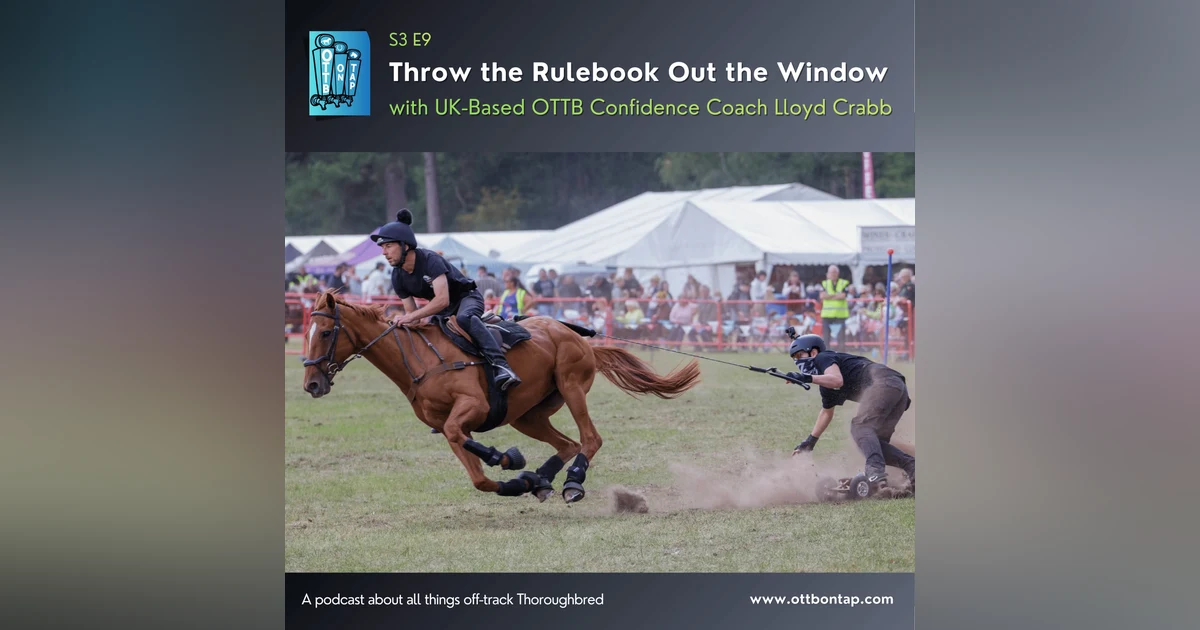
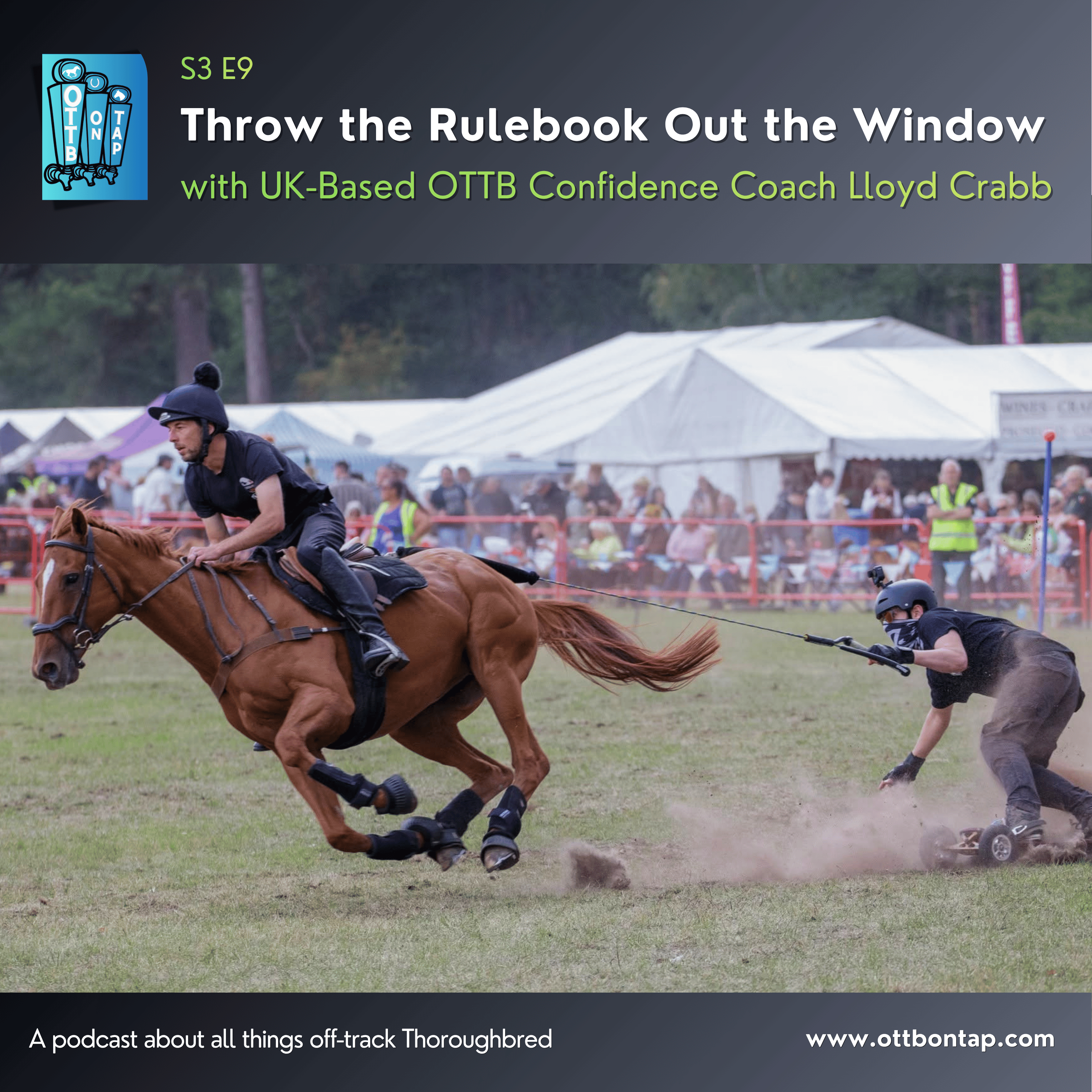


In this episode of OTTB on Tap, Niamh flies solo with UK-based OTTB confidence coach, rider, and social media favorite Lloyd Crabb for a funny, practical, and refreshingly honest conversation about retraining off-track Thoroughbreds, rebuilding rider confidence, and knowing when to throw the rulebook out the window.
Lloyd shares how he came to riding later in life, why he believes Thoroughbreds are often much simpler than we make them out to be, and how riders can build trust by learning the language OTTBs already understand from their racing careers. From bridging your reins and staying calm when things get spicy, to getting off when that is the safest choice, Lloyd brings a no-ego, common-sense approach to working with ex-racehorses.
Niamh and Lloyd also talk about UK Thoroughbred aftercare, the Retraining of Racehorses program, what riders often get wrong in the first few months with an OTTB, why hacking and happy retirement deserve more credit, and how confidence grows when we stop making every moment with a horse into a battle.
Whether you are retraining your first OTTB, rebuilding confidence after a fall, or just love thoughtful conversations about Thoroughbreds in second careers, this episode is full of practical advice, humor, and grounded perspective from across the pond.
S3 E9: Throw the Rulebook Out the Window with UK-Based OTTB Confidence Coach Lloyd Crabb [Transcript]
[00:00:00]
Hey, everyone, and welcome back to OTTB On Tap. I'm Neve, and I'm flying solo today to interview a very special guest from the UK. Today on the show we're joined by social media sensation and OTTB enthusiast, golfer, and drummer- ... Lloyd Crabb. I stumbled across his Instagram a few months ago, and have been feverishly watching his content ever since.
His passion for Thoroughbreds comes through in every post, and his thoughtful, educational content is a must-watch for anyone who wants to know n- more about OTTBs and their new career paths. And not to mention, he's got a wicked sense of humor. Lloyd, thank you so much for coming on the show today. Thank you very much, Neve, for having me, and thank you for the lovely introduction.
I'm sure that's quite overwhelming for everybody. They're gonna be very disappointed when they go and- ... check out my profile. You just a big letdown- yeah ... from the get-go. But no, thank you so much for having me. It's so fun. You're our second UK guest officially, and [00:01:00] we've been trying to get a lot more male voices on the show- because, there's just a lot of women surrounding, ar- around us all the time. So it's really great to get another male on the, perspective on the show, because I do think when it comes to retraining Thoroughbreds, the male and female approach can be an influence sometimes. But- Okay, yeah.
Got it ... let's go back to the start. Can you tell us a little bit about yourself, where you're from, and how horses came into your life? Yeah. So after that wonderful in- introduction, you know I'm Lloyd and I live in the UK. I grew up in Leicestershire, and came into the riding scene very late.
I was probably in my 20s when a friend of mine ha- was involved in racing. So with that I ended up getting sucked into that and ended up owning race horses with them and- I as in racing them. As in we were racehorse owners, and then we ended up having a few [00:02:00] and, they get retired, and then they went off to work at another place in Lambourn at a racing yard.
And I ended up getting left with two Thoroughbreds, or one Thoroughbred, I can't remember at the time, and didn't know how to ride. So I thought I best, I be- I best give it a go. Sat here with s- a Thoroughbred. And yeah, so I was about 21 then. I s- started riding them, got involved with a sport called horse boarding and thought that's what I want to do with my horses.
And ma- my wife, Sarah, while out there, moved to Wiltshire. Now I've moved to Shropshire, the lovely countryside near Wales. And yeah, now I've been riding Thoroughbreds for probably about 15 years now. Awesome. And what led you to want to start sharing your experiences through social media? Just because I think we kind of overcomplicate things as horse [00:03:00] owners, and I think Thoroughbreds, like I, I have a passion for horse racing and I know the care and work that goes involved in it, and the lack of care or education afterwards as well sometimes.
Giving them another life outside of racing is something, And I don't want people to think that Thoroughbreds are tainted, they're to- a thing to avoid, that they're not the so- solely for professional riders, when novices can ride them and stuff. So I try and help as much people as I can to show that they're not a complicated animal, they're just the same as everybody, every other sort of breed, shall we say.
And that we probably complicate them and make things difficult for ourselves when actually they're pretty simple animals. Yeah. Yeah, we always like to say that like we would take a off the track Thoroughbred over any young warmblood because they already have this like [00:04:00] library of information and things that they know and trust.
And so if you like lean into that, you can start to speak their language so much sooner than you can with a horse that knows essentially nothing, right? Yeah. Exactly. And, and especially for novices and beginners, it doesn't matter whether you're a novice rider or not, but you might be a novice as in horse owner.
And you might get one for the first time. It's just trying to make, provide that information, to provide that help out there rather than them trying to do it and getting absolutely slated on social media and getting put off. And then not want, then giving up horses just because they can't deal with the grief and online criticism, yeah. When I'm trying to, I'm out there to say, it's all right. We can make mistakes. We can learn. That's how we get experience." And we forget how that is all about having fun and why we do it. And so that's... Then, but back to your original [00:05:00] question, is just I ended up falling into it in a way 'cause I started doing them and obviously then people started getting more interested in- And like people teach you how to ride, like a bit like driving a car.
They teach you how to pass the, your test, not necessarily how to drive properly. They teach you how- Yeah ... to pass the test. And, then with horses, you're taught how to ride properly when sometimes it doesn't help you in every situation. It's not... You're out just hacking, having fun, so let's- Yeah
enjoy it and maybe not stick to the rule book so much. And nothing will humble your riding more than riding an off-the-track Thoroughbred that's just starting its new career. I always say you got, you have to be okay with being a bit of an ugly rider, and I think especially in the US there's this idea that you're always supposed to look a certain way- in the saddle, and it's gosh, if you've ever tried to get a horse that has a stubborn lead, to try to pick it up [00:06:00] there's nothing more- Yeah ... humiliating than the way that you look when you're trying to get that right. But it's like you gotta be okay with that, 'cause that's...
I don't know. It's a whole... we used to have people that were really experienced riders come out and try some of our horses, and they'd get on and they were just like how do I get it to trot?" Or you know- Yeah ... or there's something really strange about riding a horse that you get on and you go, "What?
This thing doesn't feel like it steers at all." Like yeah. And you're like if you start to start riding it forward, a lot of those problems work themselves out, right? But, for somebody that's used to having a lot of input with a horse and, they get on and they're just kinda I don't know what I'm doing here" Yeah.
And the... You would just have to adapt of how to ride them a little bit, 'cause, people say, "Oh, the horses keep running away from me," but they're probably sat deep, long-legged on the back of a saddle flapping about- ... trying to pull it back. And, but- with a death grip on the reins.
Yeah. And they're r- hands are all bare, but they're squeezing with their legs and bouncing on the back, and I'm like, [00:07:00] "No they're probably confused in what you're trying to ask them to do." Yeah. I did see a ridiculous comment the other day sh- you might agree, but somebody said about one of my videos, 'cause I try to teach people, like- how to get control in the first place, try and make sure they don't get away, and, maybe starting position's quite important when riding a Thoroughbred.
And somebody said, "Oh no, that's wrong because Thoroughbreds are... They're trained to, when you shorten the reins, to go faster." I'm like, I don't know- Yeah ... what- That's not exactly right ... I don't know any trainer that I've worked with that the horses are trained to go faster when you shorten the reins.
Yeah. It's just- Yeah ... it- It's now if you take a pull, maybe you might have something different, but if your hands are down in a bridge against the crest of their neck, like that's- Yeah ... a position they're ve- they feel very comfortable with, right? Just getting them in a nice rhythm is- Yeah
goes a long way. And and s- somebody else said, "Oh, you should be able to control them with just your seat [00:08:00] or something." I'm like- ... Okay I'll tell you what, you jump on this and see if you can just control it with your seat. See how much rein you grab then, and, you know- that sounds really nice.
Yeah. But yeah, it's just trying, just all... I'm just all about trying to help people stay safe while, and- Yeah ... demonstrating because the only way you're gonna learn in a way is just by going out and doing it, in a way. That's the only way you really learn. But if you, if there's a bit of loyalty in the back of your head saying, "Oh, bridge your reins, it'll help.
Get out of the saddle- Yeah ... and stuff," we're probably gonna feel a bit better ourselves. Yeah, and I think just we talk about it as having this toolbox of things to go back to. When you start getting yourself into a bit of a questionable spot, or you bring the horse to a new s- situation, or you hack it out for the first time, and it's if you don't have those resources to rely on, then you end up in a little bit of trouble, right?
If you're out there for the first time, and you posted a [00:09:00] great video the other day about the horse napping, which is probably one of the most annoying behaviors a horse can have . Yeah. In any regard, whether it's the gate... this is the thing, right? It's applicable to the gate, or something they're spooking at, or leaving the farm, or leaving their friends, whatever the case might be.
And, I think that's so relatable because yeah, it can just be about leaving the farm or whatever, but it's relatable in a lot of other aspects as well. And having the resources to just go, "Okay, what do I need to do? How do I guide this horse through this process?" "And how do I not get frustrated- Exactly
in the meantime?" Exactly. And that's usually what drives- it doesn't help the situation because we do end up getting frustrated, and- Yeah ... then we're not necessarily giving clear instructions, and the horse then understands less of what we're actually trying to ask it to do. But yeah. Plus you might be surrounded by people that are trying to be helpful, right?
Yeah, and the thing is I, like for instance, that video, y- I get loads of what [00:10:00] about this situ- what about that one? And I can't, I'm like, I can't, I'm just trying to give you a general- Yes, yeah ... I can't accommodate for every single, 'cause every horse is different, every reason's different, every ride is different.
But I think with Thoroughbreds and off the track Thoroughbreds, the calmer you stay, the more responsive they're probably gonna be, and the more trust they're gonna have in you to guide them- Yeah ... past that situation. Whereas if you're quite fra- fran fraught with them and frantic, they, they just get a bit wound up then.
Yeah. End up going in a dangerous situation, really. But- ... you can escalate from a pause or in a stop, and a look to now the horse is spinning and going back to the barn with you. Yeah. Really fast. Yeah. There's sometimes we've gotta throw the rule book out the window.
Yeah. Like- Yeah ... if the horse is going backwards there's no point us trying to make it go forward because we're, it's not listening to us. So- Yeah ... almost we need to we [00:11:00] then need to think about, oh, we'll just turn it the way it wants to go, then at least we're trying to keep ourselves safe rather than trying to kick it forward when we're going backwards.
We've gotta try and- Yeah, you don't want them to have bad experiences either, right? That's right. Yeah. So it's if you're on the side of a little ditch and the horse starts going backwards, like maybe you don't have any other choice there, yeah. So that's when I do my sort of...
'Cause I'm doing confidence coaching now- Yeah ... with riders. That's what I say. Sometimes, u- us experienced riders can look very calm when a horse is playing up, especially Thoroughbreds. People in racing, the horse is playing up. But sometimes it's processing when there's a dangerous situation, and, a horse jig-jogging sideways, we're probably aware that it's not a dangerous situation, but all of a sudden if a ditch comes up- like then we're probably gonna think maybe the best option is to get off or-" Yeah ... try, try and take control on the ground if we're not in control on the horse. Yeah. And I think trying to get [00:12:00] novices to understand that we don't have to battle everything. Not everything's a fight with a Thoroughbred.
We can just jump off, stop ourselves from having a broken leg or a broken arm, and then get back on Yeah ... in one piece. And I actually love that you said that because I think, I joke around that I don't have an ego at all when I ride, like whatsoever. Somebody can come to me and be like, "Oh, can I give you some advice?"
And I'm like, "Yeah." Like I love to learn I wanna know more, and like I just don't take stuff really personally, but I think that there's a lot of built-up ego in riding as a sport in general, and I think that some people might feel like their ego gets deflated by, or that they feel like they're giving up by getting off.
And I think that- They feel like a failure usually- Yeah ... is more the thing. And it's but, if you can still get the horse to trust you by doing the same activity on the ground, then what's lost there? Exactly. Exactly. And, we're not gaining [00:13:00] anything by staying on and ending up e- falling off.
'Cause then we've just lo- we've just knocked our confidence. We've knocked belief in the horse and trust in the horse, whereas actually it's all right just to get off, walk them past whatever's... Or c- try and take control from the ground and- Yeah ... who... we're not failing at all. The horse isn't learning that.
We're just keeping each other safe- Yeah ... and that's what it's all about, what do you think that people often get wrong the first couple months that they have a horse off the track? I think most people, they expect the horse to adapt to them straight away when the horse off the track.
They, they haven't been taught to stand still in a way. When you get on them- Sure ... for instance, as an example, and they're u- probably not quite used to always being out on their own, or, it's thing, just simple things where our expectations or a [00:14:00] first time thoroughbred owner expectation can be like s- it's not standing still for when I get on.
Yeah. And you're like, you're a week in and, or it's still not quite settled, and it's just like it's probably doesn't understand what you're asking it to. Same with the riding style. Maybe we need to learn how to ride how they like being ridden before we change them to how we want to adapt them or ride them.
You know- Yeah ... learn how to be able to start and stop them and turn them before we end up trying to do show jumping and, or dressage on them, like- Yeah ... just take your time to learn them and understand them and create that bond in the first few weeks I think- Yeah ... is really important.
We interviewed a jockey last year, his name is Ramon Moya, and he posts a lot of really cool social media stuff where he does voiceovers while he's at the track, and he's actually at a local track to us here. Yeah. And and it's [00:15:00] really cool because, he gets asked a lot of questions. But what I just really love is, and I wish people had more opportunities to actually go watch exercise riders and jockeys work with the horses, is like how they do things, where you see them drop the reins, you see them kick their feet out of the stirrups, or just different things, cues that the horse knows "You can chill out now because I've dropped my stirrups."
Which for a lot of people maybe they wouldn't feel very comfortable doing that on an off-the-track Thoroughbred right away, but that's a language most of them understand. And just different things like that where you see, like, how soft those riders can be, and then how deliberate they are when they're actually working the horses.
Yeah. Absolutely. And you say they, they've... It's like I've mentioned earlier, they've not been trained to go fast because you've shortened the, your reins. They've just been trained that, to be going fast or taught to go fast, but in a controlled manner. And you say when they, you drop your reins or you drop your stirrups or something like that shows that the exercise is done.
You loosen your girth or [00:16:00] something like that. And so yeah, it's a very good point that you make there. The different cues, like different understandings. That's why they don't speak, the horses don't speak English, so that's why we need to give them clear instructions of what we're asking them to do to be able to get the best response out of them.
And doing that in a nice, relaxed manner, like you say They, they understand and resp- respond a lot better. Yeah. We we talk a lot about, sometimes that concept of letting go is really difficult for a lot of riders, especially if you're a quite a skilled rider- ... and you're used to a certain amount of contact, and, whether you're an event rider or a dressage rider or whatever the case might be, like you're used to a certain amount of pounds of pressure in the reins and some sort of feeling with the horse, and that learning that ability to let go and just let the horse be out in front of you is, I think, one of the most important things you can learn how to do as quickly as possible when you first get one.
Yeah. [00:17:00] Yeah, and the, and again, it comes back to trying to remain calm because sometimes, pe- if people get run away with and they start screaming or they start shouting- ... and though that's the, that's normally our cue to be getting the horse to go quicker or something, yeah. The jockey's gonna be going down going, "Go," like gonna be shouting- Yeah.
Driving it forward. And we're like, "Ah." The horse is just going quicker. Yeah. So yeah, it's There's certain- ... things we just need to learn. I think more people probably need to probably look at racing a little bit more, and the jockeys, and think how are they all r- were riders, like you say.
How are they controlling the animal? How are they riding? Could we learn from them sometimes rather than, you say, riding deep, leg long in the saddle and expecting them to understand what we're trying to ask them to do. Yeah. Yeah. I love watching the races, like you can, on Equibase, you can watch, rewatch races of horses and stuff, and a [00:18:00] lot of times they'll show like a fair amount at the end of the race of the horse just jogging back around the track or whatever, and that's when you really get to see, like the horse move properly and- Yeah
maybe you get to see a little bit of like a relaxed canter and you're like, "Ooh, I, I kinda want that when I was a sport horse." Yeah. You get to see them being, not a racehorse, but more of what the whole picture is. They've got such personalities and- Yeah ... they just love to work.
They just love the game. Like they love to work, they love to be able to do it, and Yeah, so y- watching them in a calm state is just as beautiful as watching them when they're working. Yeah. I we have a thing here called the Retired Racehorse Project, and it's a big symposium that takes place once a year at the Kentucky Horse Park, and I took...
I w- was in it last year. So everybody gets a horse off the track and you can't start riding it until December 1st of the year before, and then everybody has 10 months. And they [00:19:00] compete across 10 different disciplines- ... everything from ranch work to polo to field hunter and eventing and so on and so forth.
And and it was really fun, but the horse that I got I just saw his listing photo and a 10-second walk jog at the track, and I was like, "Yeah, I'll take him." And I just loved his breeding too and his build and everything. And he was the strangest horse I've ever worked with in all of my years of working with thoroughbreds.
And just, I had to rethink every single thing about h- what I thought I knew about retraining horses. He was afraid of other horses. He just was emotionally unwell. Yeah. And I hate even applying that because that's just not a, that's not a stereotype I believe in really. But but man, I just I put a couple rides on him, and then I was like, "I'm not riding him."
I di- I just wanted to get him to understand that everything was fine and that he could emotionally regulate himself, and man, it paid off in [00:20:00] spades. That horse just went from being so insecure about everything- yeah ... to just, I sold him after I got back from the Retired Racehorse Project to the student of a five-star rider.
She bought him off a video, and I was like, "Oh, so good." But it, I think what I find so incredible about them is no matter how experienced you get with them, they're always gonna have something to teach you. Absolutely. They're like the be- the best teachers. Yeah. They're very good at, they're very good at communicating when something's wrong, something's right, and we've just gotta w- adapt to their language almost.
It's if you're getting an off-the-track thoroughbred for the first time or an- any time, like you just said, you... It's like getting a flat pack furn- furniture- ... without the instruction manual. We've gotta figure them out. We've gotta know what their buttons do and what does what, and it's a...
And it's like- Sometimes they're the most, I hate, I get what you're saying, like I hate [00:21:00] the stereotype sort of thing, like typical Thoroughbred. Yeah. Typ- feet, like horses, Thoroughbred feet, typical Thoroughbred feet. I know just as many other breeds with hor- feet problems as I do Thoroughbreds.
Yeah. Anyway, then, and they've probably seen just as much- Oh, yeah ... as at a younger age or something like that than people give them credit for. People get them and they think, "Oh, look, old Johnny's hacked out for the first time or cantered for the first time." It's yeah, they've done all that.
Yeah. We're just retraining them to do something, maybe trot better or jump better. They've done all the groundwork before that. Yeah. And some, some people think- they've almost got to re- re-back them, retrain them or something. Yeah, and it's nothing could be further from the truth, no. And what I figured out with that horse last year is I was like, truly, I think he rewired me as a horse person. And he I was like let me find out what he's [00:22:00] naturally gifted at. And I discovered he was really good at being inquisitive and brave. Just naturally just the very first day I got him, the hunt came through my farm, and he was like, "What's going on over there?
That's pretty cool." Whereas all of the other horses on the farm that the hunt comes through all the time are galloping around, and he was just like, "That's cool." And so I started taking him to obstacle courses, and the very first time I took him to an obstacle course, he went over a teeter-totter bridge- and through a car wash, and did all that stuff. I did it all on hand. I got on him. I, this was probably like my fourth ride on him, and he's just flat-footed "This is the coolest thing I've ever done." And he was just- ... so brave, and I was like man, if I can, every time I work with him, replicate that feeling for him will...
the riding's there. He already knows how to be ridden, right? It's but how do I get him to understand that he's got this braveness that needs to come out? Yeah. He's just, as you say, [00:23:00] it's just you're learning stuff about yourself and it, and that's why I say it's okay for people to make mistakes 'cause you try something, it doesn't work, but you learn from it.
Yeah. You learn- Or you might find out you have a horse that likes to go for, a 15-minute hack before it likes to work in the ring. Exactly. Yeah. It's you just go take it for a hack, let it walk around on a loose rein so it doesn't get ring sour or whatever, it's like you can't apply them all to the same structure. No, exactly. And everyone's different, and you feel it in them as well. Yeah. You feel the difference in each horse, yeah, definitely. Okay, so we talked about some of the th- things that we don't love necessarily, but what are some green flags that you look for in an o- off-track thoroughbred prospect?
Ooh, that's a good question. Do you like a horse that's run on the dirt or the turf or over fences or- so I prefer over National Hunt, so over the fences, like jumper. They tend to be a little easier, a [00:24:00] little more quieter, a little less wired, shall I say. A bit more experienced, a bit more like an old dog, an old pair of slippers sort of thing, so I think that's probably a green flag for me. I'm too old to be dealing with flat racers nowadays. ... They're quite sharp, aren't they? Oh, that's so funny ... but yeah, that that's my type of thoroughbred, yeah.
And I saw that you just, I don't know if you just recently acquired a new horse that was 11. Yeah. Is that right? And so y- do you like a war horse, like a horse that's g- ran a lot? They're usually easiest to get a hold of. That's fair. Yeah. Yeah. Yeah. Yeah. So yeah, so I think I used to work that horse he, he- Oh, that's g- he is, by the way he is stunning.
He is, yeah. Like he's, he looks like he's ready to go around Burley. He just looks gorgeous. Yeah. And it's, he was just one of those horses where you worked him or you rode him, like he had some time off or he came back off holiday and you counter [00:25:00] him for the first time, and he was just like, "Yeah, I know what I'm doing."
Like- Oh, that's the best ... and so I brought him back in, got him back to working. We got him, and we were just riding him, and it's just God, this is feeling great. Like he was such a good workhorse at home. Yeah. Went to the races like, it's like he forgot how to breathe. Do you know what I mean? It was just- Yeah
not, it was, like you said, it just wasn't his game. Yeah. And he's an incredible jumper. He's such an honest... And I think the owner they did try selling him, and I said, "Look, if he wants just a happy hacking retirement home forever, like I I'll put my hat in the ring sort of thing."
And yeah, about a couple of weeks later she said, ... "Walking the Walk do you want him?" So I was like, "Absolutely." Like you'd never ask. Yeah. And it, it's a shame because I did actually rec- 'cause [00:26:00] the she, they put out a horse advert for him, and there was somebody who I knew he was looking for a horse, and they went and looked at him, didn't, the, I don't know what ha- why they didn't fancy him in the end or something like that, or, and, I remember thinking you've missed a good one there Yeah.
I'm I'm just looking up his breeding right now. We're both pedigree nerds. We actually have this series that we do on our Patreon where people will send us a confirmation photo of their horse- ... and then the breeding, and then we will decide what we think the horse will look like and what we think it'll be good at, and then we'll see the picture, and then we'll break down the confirmation.
And it's really fun 'cause we, so we're we we get pretty correct on it. Oh my gosh, his breeding is insane. Yeah, he's got Galileo or Sadler's Wells on the top and the bottom. Oh. No wonder he's so fancy. All right, I'm gonna have to show that to Emily later. She's gonna freak out. Yeah. Yeah.
Sadler's Wells [00:27:00] is just... And Galileo. Galileo's can be a little bit tough, but but probably why he raced so long. Yeah, he did race quite a bit. Oh, that's cool. I'm gonna show that to her later. But yeah he's just such a Game, honest horse, do you know what I mean? Yeah. And with I think you can take it or leave it with breeding, but like with ce- certain lines and certain lineage, the class just comes right through, oh, absolutely. That's something you can spot from a mile away. There's sometimes horses where we- we'll go to the track, and we'll s- stand by the paddock, and we'll guess who we think the horse is related to. And it's just a fun game, 'cause it's like just certain lines just it's like you can't...
bernardini's one of my favorite lines, and you can't hide it. It's just there. You just, you know it when you see it, and it's really cool. This is a good segue into the next part that I wanted to ask you about, which is about the aftercare industry. Because in the US we don't have a national aftercare industry, we have many factions of it.
There are regional ones. There are some that are [00:28:00] US-based, but they have like little groups around the country. And so from what I understand, the main one in the UK is Retraining of Racehorses. Can you tell us about the organization a little bit and like what they do and their program?
Yeah. So Retraining of Racehorses is the big one of our big charities in the UK. And they're just so good at providing as much information and as much support, with Thoroughbreds, as in relating to the aftercare, the ones that they pick up or get sent, and they try and just look after and rehome and all sorts of things.
And they provide the programs for show jumping, for eventing, for dressage, for horse ball, for loads of different things where you can enter like the different classes. So when you get a Thoroughbred you can, i- if it's Retraining of Racehorses registered, [00:29:00] you can go and do all these wonderful events that they put on.
But yeah, so I've, and I'm now starting doing a few bits with Retraining of Racehorses, so I'm starting to do got a webinar coming up where I'll be doing that. And helping educate people in the first steps of, like getting a th- off the track for a bred or the care that goes into 'em.
But yeah they're very out there so that when you go to like race days and stuff, there'll be s- representatives there in different, events or country shows and stuff, And they're just a wonderful charity that provides such in- good information and support for people re-homing racehorses.
Yeah. I really I think a couple months ago, I actually reached out to the organization to see if I could interview somebody from them, and what I love about their website is like there, it's just this it's a little bit like the Retired Racehorse Project site here, but that's specific to like one big event.
But there's just a [00:30:00] ton of resources right there where it's a lot of frequently asked questions about retraining, and like- Yeah ... the amount of information just on their site is incredible. But then I love the way that they put the horses into different categories, and they've had trainers assess them and figure out like what job they might like to do, and the way that they present the horses for their new careers is really cool.
Yeah. And it's just sh- showing and providing education for everybody who, to show that whole once racehorses have finished their career, they're not disposable sort of thing. Yeah. They, it's look what they can do, look where you can go and do. Yeah. Look what, how much fun you can have.
And they're now doing, introduced a hacking challenge sort of thing. So you don't even have to go out show jumping, dressage. You can just record your hacking on an app And do it with Retraining of Racehorses. Yeah. So you ju- you just go out hacking. It doesn't have to be feeling you gotta go out and compete, yeah, they do have something like that here. It's called [00:31:00] a Thoroughbred Incentive Program. And so certain shows you'll go to, you can get a high place TIP award- ... for having the highest placed Thoroughbred in different divisions. They'll give out special prizes, and then they have a championship every year as well.
Yeah. But they have a some- something similar, like a hacking or I have a friend who just started to do endurance riding with her, one of her Thoroughbreds, which is really cool. And you just, the, you can just keep accruing miles and get like a bronze, silver, and a gold medal through the Thoroughbred Incentive Program- Brilliant
which is pretty cool. I don't know how people do endurance riding. I know, honestly. I- I think she did she, she did her first, it was, like, a clinic, and so they did a bunch of different things, but then I think they finished with a mock ride, and I think she did 19 miles. And she said her horse didn't settle for the first 10.
Yeah. Yeah, I know. My bum backside gets sore after 14, so- Oh, my God. That's, honestly. I mean- I'm like, I don't know. Maybe I'm broke- maybe I'm broken. I'm also almost 50, so it's yeah, it doesn't get any easier. No. And they but [00:32:00] yeah, Retraining of Race... They do an awards, they do awards as well, and a championship, like you say.
It's definitely becoming more of a thing as well, a recogni- recognition sort of thing, and people are getting- And Oh, yes ... do, does the organization work directly with the trainers at the track or the tracks, or is there like a liaison that w- within the tracks around the country that will then reach out to the organization?
Or do you have any idea? So they, they work a lot with the trainers. They're, I think they're doing a lot more where they're educating the trainers just as much as the people who get them after to, to show that they've got all this support for when the trainers are finished with the horses.
Yeah. And that they can move on that way, and then they go to the tracks to put out stands and demonstrations to the people out there to show what they do basically. Yeah. And this is something that, th- they're, like in the US they've gotten a lot better at like placing [00:33:00] those opportunities for the trainers, but what we're still seeing, and it's gotten in a little bit of a rollercoaster, is the prices that trainers want for horses off the tracks.
Certain tracks build in incentives for trainers to place their horses when they're done running, right? But then you have organizations like Canter, which is a US-based program, and they have regional groups that work with different tracks. We have, I don't know what the prices are like in the UK coming right off the track, but like- Do you know, I was just about to ask you the same question.
Yeah. So 'cause I'm just, I'm kinda curious, so when we were buying and selling horses, so this is probably like 2017, 2018, we could get horses either free or for $1,500, and you'd get 'em in and it was great. Now that there's actually a lot more infrastructure with the aftercare organizations and the trainers kinda know these horses are worth some money, and I apprec- and everybody appreciates the fact that like you might have a horse that was bought at auction for [00:34:00] $350,000 that you've spent $85 a day getting it to get its gate card and all of this stuff, right?
To only to find out it doesn't really wanna run or it doesn't- Yeah ... run that well, or it bows a tendon or whatever the ca- case might be. And now they're asking like five grand. And I would say right now the prices right off the track kinda vary, but I would say five grand is like for A 16-hand gelding with no known injuries.
And then if it's fancy, if it's big, if it's a nice mover, if it's got any white on it, if it's gray, I mean you're talking like closer to 10. Do you think that's right or? I love it because I think there is so much value. The thing is like when you see resellers selling their horses for $2,500, it's doing nothing to help the industry.
I do think it, it's hard for quality people to get the horses off the track if the prices are too much. I do think there's there's still like a black [00:35:00] mark over Thoroughbreds as being worth a lot of money. I sold my last Thoroughbred that I had for five years for $40,000, and he had kissing spine, sesmoiditis.
Like he had a lot, he had a lot. But like I was like, "He's worth this much money." Yeah. He's an amateur's dream. Whatever. And so I think that it's, it, the more we can do to support that these horses have value, there's just gotta be a little bit of give and take from the ground level up, right?
Yeah. So I'm a bit on the fence about it all really 'cause I get... So there's obviously this thing, isn't there, where amateurs, I wouldn't say amateurs, or novices or beginners, they apparently buy Thoroughbreds because they're cheap. And again, I, people, but I don't particularly, I think that's, we need to educate more the people than necessarily making [00:36:00] them expensive.
Like- Yeah. Yeah ... what horse you're gonna get is, we still need to educate the riders into... Anyway, but then I know people put a bit more value onto the horse, 'cause one, they probably think it's worth a bit more, but they think if you're paying 5,000, 6,000 gra- pounds for a ex-racer, you're gonna look at, you're gonna, it's gonna go to a good home.
Yeah. Because if you're paying, that means you're gonna look after it. So I but I'm in, the way I say I'm on the fence, 'cause I understand that. Yeah. But when they come off the track, for me they're probably not worth a lot. They're, but- Is that because I've never brought an ex-racer?
M- I can definitely see your point. You know what I mean, like- Yeah. Yeah and I do have a good resource now where he gets really good quality horses, really good owners, and, offer to me, offer them to me for, nothing. Yeah. But, that's because [00:37:00] he knows that if I bring a horse in, it's gonna get quality farrier work, it's gonna get a proper feed program- it's gonna get all of those things in place. And I think to your point, there is a specific price point where you attract riders of less experience. And so that's the tricky part. It would be great if you could just offer all the horses at $1,500 knowing that they were gonna end up in good homes. But the truth is how- whatever you pay for a horse is the least expensive check you're gonna write when you have a horse, right?
Like- Yeah ... so if you get it for free or five grand or whatever, it's that's meaningless unless- Yeah ... you can actually take care of the horse. And so there is some danger in offering them too cheaply, but it's like, how do you keep the machine going? No it's a very difficult thing.
And like you say, the reason, like, when you're buying and selling like you were, you're actually bringing the horse on to put value onto [00:38:00] it. I- if you know what I mean. You're bringing it on and jumping a few show jumps or doing a few dressage or whatever it may be, and you add value to it.
Whereas when they come straight off, it's just the thing it was trained to do, bred to do, or is experienced in, it's no longer doing that. It's retired from that. So it's Yeah, the price of it, just because it's cheap and maybe attract a novice, doesn't mean they're not gonna love and learn it and care for it as much as it would be if it was five, six grand.
Yeah
But I go back to my point of, I've, I would never pay 'cause I know that they're not worth much at the time when they come out of racing. I know that probably sounds quite harsh but then I'm not going on show jumping. I'm not going out competing. I'm just- Yeah ... I've given them a home for life sort of thing, and- Yeah
I know. There's gotta be, there's gotta be both, I think. Yeah. There's gotta be [00:39:00] a- access points for people to be able to get these horses for, either nothing or next to nothing to, to quality homes, and then also a safeguarding. The last thing anybody wants to see is a horse with a tattoo or a microchip in a kill pen, yeah, and also, normally if you, if a horse gets given away it's normally because the owner or the trainer knows you. Knows somebody, yeah, exactly. Yeah. It's not normally just "Here you are. This horse is on the edge of the street. Come pick it up." It's got a little sign around its neck.
I've thought about buying and selling sometimes, but, I can't I don't 'Cause I know people see how good I change these horses and what- Yeah ... I'm capable of, but I just can't sometimes be bothered with the hassle that'll probably come with it. Yeah. Don't really recommend it. No
We got out of it for a reason, I have been, we've both been very lucky with some of our horses. But there's a lot of heartbreak that comes along with it too and it can be quite frustrating and- ... and the- No, it- ... and the ebbs and flows of the [00:40:00] market can really crush you as a reseller.
Oh, exactly. And you can find people who probably aren't educated with thoroughbreds so much, and it comes back to the thing that in two weeks, it's not jumping quietly around a showjumping course like what they expect it to. Yeah. And they're trying to get, say, get rid of it, the horse, and almost they come back to you saying you've mis-sold them something.
Yes. And that, we see that a lot now with, we have one reseller in particular who is very vocal about a lot of the stuff that goes on in her sales, and it's awesome because it just highlights, like, how, even if you're a person right now that for me, I've had my current horse for three years, and I've moved him twice.
He's golden. He's such- ... a good boy, right? He's very experienced. But every time you change a horse's environment, it takes them weeks, if not months- ... to re-acclimate in both their mind and their body. So it's like just because they have the training and, or [00:41:00] they, and they're, they have the training that was advertised when you went to go try them now you're taking them away from any friends they've made- the comfort of their routine, and so on and so forth, right? And I think that I wish there was a better way to educate horse owners about how important their horse's emotional regulation comes into play. Yeah. But that, that comes down to confidence and knowledge as well. Yeah. If, say for example, if like we got a horse in the trainer brought it, came in on Friday, I rode it out on the Saturday.
But I'm confident in doing that because the horse is gonna have clear instructions from me. Yeah. Like when we got Walkers home I did let him settle in for a week, but that's more 'cause I was busy, but I still would've been confident enough to take him out the next day- Yeah ... to be able to instill that [00:42:00] confidence in him because he's "I'm in safe hands."
Like- Yeah ... but yeah, if you, if the rider starts to doubt themselves and yeah we've gotta think that give the horse time to settle in, 'cause obviously you're not quite sure of- ... his behavior and stuff and- Yeah, and we always say to people that like if you get the horse home, and say the horse is unsettled in a new environment, that doesn't mean you don't...
Y- it's okay not to ride them. Oh, yeah. But thor- thoroughbreds thrive on a routine. And they love to work, right? So tap into that and go take it for a hand walk around the property every day, or whatever the case might be. Like there's- Yeah ... so much that... Like I, I think last year in particular really taught me that like- The riding is just one very small component of understanding these horses and, there's so much more that we have to offer them that comes from all of the other aspects- of just spending time. Yeah I don't know. Like, when you think about spending time with a horse that's on [00:43:00] stall rest, right? Like I went through, my horse got kicked last year and he needed stitches and was on stall rest. The amount of information I learned about him while he was on stall rest really- Oh
helps me because then when I took him to Kentucky and he had to be in a stall for seven days- Honestly, yeah ... with no turnout, I was like, "I know exactly what it takes to make him feel comfortable," honestly, yeah. I can't echo that anymore because I have people come up to me and they say I just don't quite trust my horse."
And I'm like, "How long you've had it? Three weeks? And it was on box rest for one week, and you've been riding it two weeks." Like- ... come on, you don't know the horse. Yeah. You get to know the horse. Like you said, take him out with a head collar where- Yeah ... in lead rope where you walk him because it's like being, like riding a rollercoaster.
If we go ride that rollercoaster once, we get it all for the first time, we're gonna be like, "Oh my God," like it's- Yeah ... we don't know it. We're gonna be excited, we're gonna be thrilled, it's gonna be scary, it's gonna be anxious. Whereas if we keep get to know the [00:44:00] rollercoaster, if we get... We're gonna know every bump, every twist, every turn, every sound, every crank.
And that's what I mean by getting to know your horse. So walk it down the road in hand. Yeah. Get to know how it reacts to when cars come past, get to know how it reacts when a cow is in the field or a gateway comes up or a trash can, as you say over there, yeah. A, like a wheelie bin, for instance, over here, yeah The more we get to know them, the more we understand them, the more it dilutes the problem and instills confidence and trust into each other. So we actually start respecting the horse more, and the horse respects you a lot more. Yeah. And those hours spent not riding and spent with them, I think to me are so invaluable.
I got him this, He's a, like I said, he was a really curious, playful horse, and so I would put him on the cross-ties and I'd pick out his stall, and he just started eating the cross-ties, and I was like, "Oh, my God." So I'm like, "What am I [00:45:00] gonna do?" So I got him this it's four feet long. I called it Stall Rest Stanley.
It's like this big fluffy bear with all these little squeaky... It's a dog toy, right? And it's crinkly things, and you can tie it in a big knot, so I'd tie it on the cross-ties. He loved that thing so much. I brought it to Kentucky with us. He would nap on it. Like- ... it was just his favorite thing in the whole world, but it was like I'm not gonna try to get him to stop doing that. I can't get him to stop doing that. I'm at the barn by myself alone, right? He's gonna stand there and chew on the cross-ties. So I'm like what can I do to just let him still be playful and not take away from his personality?
Yeah. Yeah, it's just I think people underestimate How rewarding it can be spending just downtime with them. Like- Yeah ... I, me and my wife, we used to, when we go and feed the horses sometimes, like especially now when it's a bit nice in the evenings, we'll go take a beer with us- Yeah, just hang out
and sit on the log and w- wait, just chill around them, enjoy the time. Like- Yeah ... that's the [00:46:00] whole point. That's why we do it. And watching them interact with other horses is also really cool. You know- ... the dynamics of the herd you can't learn enough from that. I went to go, there's a new horse, an Irish horse, at our farm, and I don't think he's been turned out with other horses, and he's very confused.
And he's big, and I have a small Quarter Horse now. But there's a two-year-old in our field, and he's tiny, but he doesn't know that he's small. So I go to get my horse. This giant Irish horse comes galloping across the field at me. I'm like, "Oh, here we go." So I had a fly, fly mask in my hand, and I just start flinging it at the big Irish horse.
This little two-year-old buzzes around my Quarter Horse and is like, "I don't think so," and started protecting us from this Irish horse. Yeah. And I was just like, it's so funny when you watch... i'm like, "I'm part of the herd now." I'm in- Yeah ... the middle of this. And I'm just like, oh, my... But it's just fascinating, right?
To watch a horse that doesn't really know how to interact with the herd, the little one being like, "You're coming in [00:47:00] way too hot," and my horse being like, "I'd like to leave." So it's just funny. Yeah. It's funny as well as somebody asked me a question not too long ago and said, "Do Thoroughbreds make you a better rider?"
And I said, "No, I don't ne- think they necessarily make you be- better rider, but I think you learn quicker with a Thoroughbred." I think, I think if you're a novice- I don't think it will make you a better rider owning a Thoroughbred, but I think you'll learn quickly of how to become a good rider.
And I- Yeah ... I think they're very... I don't know what you think about that, but. It's interesting that you say that, 'cause I think I have a very good friend, she's got an Irish sport horse, and she said, and she's ridden Thoroughbreds and competed Thoroughbreds, and she's "I'm just not cut out for Thoroughbreds."
She's "I'm just not a..." And she was with me in Kentucky the first day when Oscar was climb, trying to climb out of his stall, [00:48:00] and she's "What are you gonna do?" And I said I'm gonna go check in at the secretary's desk and he's gonna have to figure it out." Like- Yeah ... I don't have anywhere to put him.
I was like... She's what are you gonna do for the rest of the week?" And I was like I'm just gonna hand walk him a lot." Yeah. I'm just like, I see that behavior and I'm like, "He's okay. He's just throwing all of his toys out of his playpen." Yeah. It's like- It's it's all right.
I'm like, he has emotional resources, he's just not... he hasn't taken a breath yet. He'll be okay, I sometimes think we're or it makes us feel like we're tough on them sometimes because- No, I know. ... b- because other people are like, "Oh my, that horse is threatening the box." Yeah, he'll have to deal with it.
He's gonna have to get over it. 'Cause I ain't doing anything different. And listen, this might be a little bit because I'm Irish. Yeah. That might come through a little bit where I'm just like- Sure ... he'll just cry it out, he'll be fine. What, what are you... f- he's gonna have to deal with it.
He's knocked his feed over. Yeah, that's his fault then, innit? Yeah. He'll not get any food then, now, will he? Yeah. At one point when he was at his worst, he got [00:49:00] both of his feet into his water buckets, and I just looked at him, I was like that was stupid." And then he's stuck in the water buckets and I was like- All right.
Like whenever you're done, come on. Like you gotta- Yeah. And I think it c- it comes back to understanding when a situation is dangerous- Yes. Yeah ... or not. Very much I don't want it, I don't want it to sound like I'm being cavalier about horses doing- No, but if they're just gonna walk round a box, they're not doing any- or knock over their feed or make a racket.
But if they- Yeah ... start climbing over the door and getting stuck, then- Yeah ... it's- Yeah. Like I, my response was like, I was like I'm not gonna put the stall guard up today." But maybe in a couple days. And by like day three, he's standing there asleep with the stall guard, with a hay net over the door, and he's happy as a clam, yeah. But, let's go back to your social media platform and what your kind of message is. It, the biggest takeaway I'm gathering is that you're here to teach people about confidence. So why do you think so many people struggle with [00:50:00] confidence? I think because we get older.
Yes. We get more scared of the what ifs, or we become more aware. And when we start to doubt ourselves or doubt our confidence, then we're not- connected with the horse. We're not trusting the horse, like you said. We're not giving clear instructions. And people just don't know where to turn, what to do.
And I just thought how can I help? And that's by just having it, having my soothing, charming voice talk to them- ... about it. No, it's just about trying to lift, let them lift that expectation off them, trying to make sure this is all still enjoyable. 'Cause when we start comparing, we're never gonna be like we used to be, 'cause people say, "Oh, I used to not be scared."
It's y- we're different now. We've moved on. Yeah. We've gotta do it. So yeah, my, that's basically why I do it, 'cause just to try and help people out enjoy it again. [00:51:00] Yeah. I think about it in the sense that normalizing fear and normalizing anxiety and insecurity is something that the horse world needs a lot more of- because I like to say that the more you show that to the light, the weaker it gets. So I think by talking about it and sharing experiences and having that solidarity, we realize that we're not alone in our struggle. Yeah, and we've got to think of the what ifs. Yeah. It's okay to be- Yeah
to be like, "There's a scary thing over there," or, "I'm a little bit afraid of hacking out- ... on my own," or whatever the thing is that paralyzes you. Yeah. But it- And it's almost actually trying to make you remember that the horse, you probably need to trust the horse a little bit more, because the probably horse hasn't reacted to it, because we go, "Oh my God, there's a gateway coming up" Then the horse-
just go, goes what the hell? I wasn't worried about-" "... something, but now I feel like I'm worried." Then you go, "See, I knew you were gonna react to it." And they're like I wasn't reacting 'cause I was only reacting [00:52:00] 'cause you were reacting." Then the snowball effect starts, and we're like, then we lose control.
So yeah, it's just trying to say to people, "It's okay, we get older, we get more aware of the risks- Yeah ... involved, the consequences of injuring ourselves and stuff like that." And, but I'm trying to make us try and slow that snowball effect down for it, from it maybe being okay to becoming a disaster.
Yeah. And that's why I say "Let's try and work out what is a dangerous situation. Are we in control? How do we slow that snowball effect down?" To try and stop it ending up in a ditch or ending up and thing. And it's usually fear, the fear that, and lack of confidence us- is usually brought on by the feeling of not being in control.
Yes. Yeah, no, I think that's a really good point. It's not normally, if you get bolted with, 'cause that's usually a lot of time that people get scared is the horse bolts. [00:53:00] It's not ne- normally the speed that scares you, it's the fear that, the feeling that you've got no control. You're a complete- Yeah
passenger. Yeah, just trying to help people find the love for it again. Yeah. Do you think that horses can tell the difference between confidence and bravado? Yeah. I think you can get a lot a horse, I wouldn't say respects you a bit more, but it they're like... where... If we're not giving, if we're not confident on a horse, we're not giving them clear instructions.
And then that resorts into the horse going I don't know what you're asking me to do. You're not in control. I'm going to take control." Whereas when you're riding one or something, you go, "Come on, let's go." They're like okay." And so people do get away with it for sometimes. Yeah. Or, the, people do get away with it, but it'll probably find them out at some point.
Yeah. I always go back to this thing that Lucinda Green says, which is, "When a horse asks a [00:54:00] question, it's wrong not to answer." And I think about that a lot when you're talking about things like, oh, the horse is looking at something like a mailbox or, it's feeling insecure or whatever, and it's like the horse is constantly asking for reassurance and- yeah ... dir- direction, as you would say. Yeah. I always like to think of them as toddlers that, basically thrive on boundaries and limitations, so Yeah. And it's like the way we deal with... say again, it comes back to we think of the what ifs or with the, and, but we've gotta have that, but assume nothing's gonna happen.
Same with a mailbox. If we go past the mailbox and the horse goes, so let's just keep on moving past it. We don't have to make them look at it. We don't have to create an issue out of it. Yeah. 'Cause the horse will feed off that as doing, all right, it was okay. We're fine. Yeah.
And it's fine, yeah. So yeah. And, it's like- Picking your right battles. [00:55:00] If you bec—have a battle, there's a winner and a loser, and we're probably gonna be the loser- ... nine times out of 10. Yeah. So even little things like picking their feet up or picking their feet out, if they pick up the opposite one to what you're asking for, just pick out the one you've pic- they've picked up.
They're trying. W- well, they've picked up a foot. Yeah. Who cares if it's the one you want? Yeah. Like- Yeah ... you don't need to go, "No, Trevor, no. I want this one." Then all of a sudden the horse is like, "Come on, what? Bit harsh, man." Then- ... like- It's like I'm j- I just offered you something. I don't know.
Yeah, and then we get frustrated, then we have- Yeah ... that feeling of they're not doing what we ask them to. Yeah. When actually th- we just, we could just pick up the feet and crack on. Yeah. Yeah, it's not that deep. Yeah. W- what advice would you give to somebody rebuilding confidence after a fall? Ooh, good question.
So don't be [00:56:00] afraid to start again. I think going back to scratch, as what we've talked about, walking them out in hand, doing that for a bit, getting used to them again, t- building that trust with your horse, realizing are they doing anything wrong? Was it something... Almost parking what you did and accepting that you've fallen off.
Wondering did the horse do anything wrong? Could I do anything better maybe? And, but just get back on, go five minutes down the road, come back, jump off. Wahey, we're winning. Like we don't- Yeah. Yeah ... we don't have to get to back to where we were straight away. We- Yeah ... don't have to question that.
So just be prepared to take those expectations off and go back to the beginning. Yeah. Have you ever had or gone through a major confidence challenge yourself? I think ev- every time. I [00:57:00] think ev- ev... Yeah I think Yes. I'll te- okay, I'll tell you this story. So it, we were horse boarding once at, funnily enough, Burley House.
Oh, that's so fun. Yeah. And we went 30 mile an hour into a corner, and the horse, I think it was, like, it was about 30, 28 or something like that, and we didn't realize that the Paddy, our horse, had lost a stud or a shoe or something like that. So her back end went. She stayed up, and I pumped up, went, plopped up and went back.
And, yeah. But we still had one run left, and we hadn't got tied down or something. So to try and do that again and go that fast into that corner Trusting the ho- like, that's where you've got to go, "Come on, Paddy you've got this, and I've got [00:58:00] you, and you've got me," to just try and actually think it actually wasn't her fault why we fell.
Yeah. There was nothing I could do. So yeah, that, that was quite scary doing the- Yeah. ... trying to go. So I understand and I completely resonate with people who do lack confidence. And, like, when I first started riding, I thought it'll be lovely to canter my horse, my thoroughbred, without any experience down this avenue, and I couldn't stop, ended up having to jump off, at high speed and yeah.
So they can be quite scary, so I understand, and I suppose that's why I try and help people. Yeah, and I think I had this question in here about fear. What's something you wish every horse person understand about or underst- understood about fear? And I think you're getting at this, which is that it just exists.
Yeah. Everybody has it. Yeah. It's at the end of the day, we're just passengers. Yeah. [00:59:00] We're passengers- And, and- ... ... for us to pretend like what we do every day isn't, putting ourselves in danger is silly because every aspect of being around horses- ... is going against thousands of years of breeding.
Yeah. And, yeah. And it's wh- when we're passengers in cars, none of us are... I don't know a person that's really good at being a passenger if we know how to drive, we always- ... we can tell the driver to go left we can tell it to slow down, speed up, but at the end of the day, they've actually got control, and you know when they brake a bit late and traffic's coming up-
we brace and- Yeah ... yeah. And it, horses are very much the same, but we can actually try feel a bit better if the horse is... If we're trying to get a horse to s- stand still and it doesn't want to, and it wants to walk on, if we just go, come on then. Let's walk on," when we're ready to, even though they're not standing still, and it's what they want to do, we can actually feel like we're in a control a little bit.
Yeah. Yeah. Same with the horse if it goes backwards. If it wants to go that way, let's turn it that way and at least feel like [01:00:00] that's what we- Yeah ... wanted to do, even though the horse wants to go that way. Yeah. There's still a small win in there somewhere. But yeah. I think it's... I always tell people we, fear is just something we're gonna have to- Live with when it, when riding horses.
We, we, if we think about it, we could just go around the corner on a horse and a tractor comes and clears us up, like the worst thing that could happen. But we've just gotta try and assume that it's not happening, and how we can have a plan and strategy in case something does go wrong. Yeah. Like slowing it down to maybe jumping off.
I, It's funny that you made that analogy with the car because my boyfriend, for a hobby, races cars. And So anytime I'm in the car w- I have a pretty fun car that I drive, and it's a six-speed turbo, but, like- ... driving with him, even just going around or going out to eat or something, I'm just like, "Do we have to drive like this every time?"
Or- yeah ... can we But then I suppose how much would you enjoy it if you're [01:01:00] worrying about it or just going- Exactly. Yeah ... affecting, how much is, how much more un- enjoyable is the journey if you're going, "Ooh." I know. It was funny 'cause I took my car to the track last year. I did a whole track weekend, and I remember afterwards I was like, "Okay, so it's official.
I like really fast cars and slow horses." I feel much more comfortable in a car going- Yeah ... really fast on a track that I don't know how to drive on yet than I do on a horse going at some l- level of speed. Back to social media, I wanna, have you had any conversations that have surprised you since you've been doing this?
Oh oh, crikey.
Yeah. I c- some of the... Facebook's the worst. I don't- Oh, yeah, 'cause the people just can't help themselves I, like I say, I'm not sure if it... I don't know why Facebook, I seem to get a lot of stranger comments [01:02:00] and, more questions asked. But, Yeah. No, there, there is some funny ones where you're just like, "Really?"
I get a lot of advice asking- Oh, I'm sure ... when it's like the craziest situation.
Like how much time have you got? Like I, I can't- ... I can't solve your horse problem within one message, and yeah. Or if you, or say if I put like an educational video about the horse napping or something like that. And then I get what if it does this and there's this situation?"
I say, "I can't c- I can't accommodate- Yeah ... for when there's a bin lorry and there's horses in the field." And at the end of the day, my horse isn't actually napping, so I can't like- ... yeah. You're trying to fabricate the- I'm trying to demonstrate it. And I think I...
Another funny thing is, I know this isn't stories like you're probably looking for, but- no, this is great. I love it ... I did a video about- controlling a thoroughbred basically, but I didn't state it was for thoroughbreds. I thought it'll be useful for all [01:03:00] horses. Sure. And comments were like saying, "Maybe you should state this is more for race riding or thoroughbreds."
I'm like okay." Then the next one I put up was like- Oh my God ... about thoroughbred, saying, "If you've got a thoroughbred," and the comments were like, "This isn't just for thoroughbreds, this is for all types of horses." Oh my God, you can't win. I'm like, "Oh, my God." You can't win. Why, there's always or something where it's just...
Yeah. I was actually thinking about you regarding that because there's a lot of people in the US right now for the World Cup, and- Yeah ... there's this guy who is English and he's... I don't know if he's moved to America. Anyway, he's been chronicling trying American foods, and so he was really excited about trying grits.
And I posted in the group "Next up you have to try scrapple." And he wrote back to me and said... And I said, "Oh, it's a Pennsylvania treat or whatever." And he said what's scrapple?" And I said, "Oh, the better question is what isn't [01:04:00] it?" And I was like, "It's legendary," whatever. And somebody wrote below that, they got really upset with me and they're like, "Come on, he's from the UK, and he doesn't know what...
And I was like, "But no, that's really how you would describe scrapple." It is a gray rectangle of what's left over when they process pork- Yeah ... in a factory, and they put corn meal in with it, and then you slice it, and you eat it with breakfast food. Oh my. But it was just really... But it was like the person was really upset with me.
They're like, "He doesn't... He's just asking for... " And I was like, "I was trying to be funny. Chill out." Like- yeah ... oh, my God. Oh, it's mad, isn't it? It's just, it's crazy. I was like, I have all these like notifications. I was like, this is so funny. Hold on, I lost my, Oh, yeah. What kind of topics do you think riders need more education on?
Put, really putting you in the hot seat now.
That, yeah, crikey, that is. It's hard. I think learning how [01:05:00] to control a horse. Yeah. I think again, not riding to the book. It doesn't necessarily help you out on the road sometimes, like dealing with certain situations like napping or spinning or spooking that. But- Yeah maybe something like that.
Maybe just more like hacking advice like I tried to do. Everybody's so much of Trying to educate in the school, if of how to do maybe get on the right lead or the right- Yeah ... the right diagonal or something like that. And we're actually forgetting some of the more important maybe topics of everyday life with horses- Yeah
rather than just the schooling sort of side of things. Yeah, and I think there's a little bit of a myth that you're gonna take a thoroughbred out and it's naturally gonna be forward, and I think a lot of times [01:06:00] they're not. And I think you can teach them to go forward out in a nice area with a big straight line- Yeah
and use that to your benefit back in the ring. I think I suppose if I'm answering the question honestly, I think we could probably learn how to work ride a little bit more, shall I say, as in learning how to control a thoroughbred before... Or ride like we're in racing before trying to adapt, ask them to come and adapt to our style of riding, because at least we know how to start and stop them.
Yeah. If or control them. But then again I was cantering in a straight line and somebody said, "You took off on the wrong leg," and I'm like- Oh, my God. I'm going in a straight line crikey. God, and that's the point. That's why I try and- That's so funny
thank novices and because that would probably make a novice or a beginner feel like they're doing something wrong when they're not. Yeah. Yeah, it's like- But nearly said I went off on the wrong- It's like you just cantered off quietly, I don't care. Seriously, like, why are [01:07:00] we making it complicated?
I've just cantered, Oh, my goodness. That's really funny. So I guess in controvers- controversial questions is there a piece
of horse advice that you see getting shared online that makes you cringe every time you see it? Oh. Do you know what? I-
I I, yeah, no I got told off for patting my horse the other day. Maybe that's a bit of advice that- Oh, yeah, I thought I saw something about that Yeah, maybe that's- 'Cause you were, like, patting 'em- Well- ... and not rubbing them. Yeah. I didn't know that was a thing, so maybe that's probably one a bit of advice I'd like people to ignore.
That's so ridiculous. Yeah. It's I know for some horses horses like different types of, I, I call it their love languages, right? Figure out what your horse's love language is. Does your horse like cookies? Great. Give it cookies. Yeah. Does it like to be scratched at the wither?
Cool. Do that. It's not... any reward for the horse can translate as a [01:08:00] reward at all. It's your, it's your- it's your demeanor that the horse feeds off. Yeah. So if you're patting it, but you've got that obviously light tone in your voice, that could- Yeah ... bore you or something, they're gonna respond to that rather than, you're growling and pat.
There's- ... different ways of- so yeah- I like that ... maybe I think I s- I do struggle with the natural horseman sort of- Yeah, no, and there's... The thing is like last year I got really into I don't know if you're familiar with the TRT method. It's the guy from- ... Holland, and he does fantastic training.
Yeah. And at its core you would be like, "Oh, this looks like natural horsemanship," but it's absolutely not. It's truly just about em- emotional regulation and working within the confines of, like- ... what horses are naturally adept at doing and how they can unlock themselves. There's no carrot sticks involved or things like that.
No. But yeah, I think there's a time and a place for, b- being sweet and kind, [01:09:00] and there's a time and a place for this is a 1,200 pound animal that could kill you if it wanted to, just by reacting. And I- Yeah ... I, yeah. I think it was like, like you say the me trying to s- start educate people into having a good starting position when they canter, so almost like the horse is almost cantering on the spot.
Yeah. I'm exaggerating the way I'm demonstrating. I obviously don't ride with them "Ooh," like this. Yeah. And 'cause I'm trying to exaggerate it to, to show people, and they can work it out for themselves a little bit of the feeling that the horse is giving them. Yeah. And again, somebody was like, "You should be able to ride from just the seat," and I'm like okay, but my...
The, my videos are actually for a beginner, like somebody who hasn't got years of experience." Yeah. And they said yeah, no, they're not. My kids were taught from five and six." And I said aren't they lucky?" Not everybody- Yeah ... is. We've gotta- ... learn how to control them before we can go teaching them- Yeah
how you wanna ride- and- ... and adapt. Yeah, it's just- Yeah ... and like we were saying earlier watch how they do [01:10:00] it at the track. Like, all those horses are ridden in a frame. They're not ridden around with their heads up in the air doing nothing. No, exactly. And- they're ridden using their backs and- I-
expecting some sort of contact and- Yeah, and the riding style's different, western and- Yeah ... the English, and yeah, it's just... So yeah. Yeah. And like- I may not... Hope I answered the question ... I think a lot of people make the mistake of riding them a bit too loose, and then I think when one of your videos you talked about sometimes they'll step into the canter, and they'll take two steps where they feels like they're bolting.
They're really not, they're just out of balance, right? But if you have nothing and you're trying to c- catch your reins, and you're doing all this, now you've slowed the forward momentum, or you've confused them 'cause you're up there scrambling around, and if you already have a nice hold of them, you can just sit, wait for them to kinda settle, and then go, yeah. And I think sometimes as well, when people pull a horse up, they sometimes maybe expect it to stop straight away. And whereas the thoroughbred can, [01:11:00] just 'cause they're not stopping straight away doesn't mean they're not slowing down or listening to you. They could just take a bit longer to pull up yeah. You almost forget that they're like elite athletes. Exactly. They are the- ... they are the elite athletes of the horse world, yeah. Yeah. Yeah. And especially when you get them off the track. They are as fit as you're gonna get them unless they've had- Unless you have a- ... time off
thoroughbred horse, yeah. It's a different animal. I've got a little quick-fire, rapid fire round- Okay ... to ask you. Ooh. All right. Your favorite thoroughbred trait. Their lop along canter. That's not what I was expecting you to say. Most misunderstood thoroughbred behavior.
Jogging. Favorite song or playlist while you're riding? Oh, bloody hell.
Come on, you gotta have something [01:12:00] on repeat My music collect- collection's too vast to be able to accommodate that question Maybe now you're gonna have to come up with a Lloyd Crabb's extended hacking Playlist. Yeah So you can show the variety on there Yeah. All right. I'll let you, I'll let you go with that one, but I'm expecting a follow-up- Okay.
All right. Thank you ... down the road. Okay. One training exercise that every off the track thoroughbred owner should know
Hill work is really good if you wanna keep 'em fit That's an excellent one. Okay. Dressage, eventing, showing, hunting, or pleasure riding? Pleasure riding the most impressive ROR horse you've ever seen
Walk and walk I knew you were gonna say that Anglo Paddy. Yeah, Anglo Paddy. Anglo Paddy. I would say I, I'm gonna go with my chestnut mare because [01:13:00] she's done music videos, she's done jousting, she's done filming, TV, she's done horse boarding, she's done everything. And you buried the lead with her.
We're gonna have to do a whole follow-up episode just on her. Yeah. Let's see. The most underrated second career for a Thoroughbred? Ooh
I think retirement. I think, happy hacking, I think that's so underrated. Yeah. We don't have to go out and do things, we can just enjoy, joy them, enjoy them. Imagine that. Yeah. One horse you'd love to ride for a day? Oh. There was a horse called Denman that Paul Nicholls trained and won the Gold Cup at Cheltenham and was a very fantastic horse.
Yeah, I'd love to ride him, but he's no longer with us. All right. Beer, bourbon, coffee or tea? Beer. One thing every [01:14:00] off the track thoroughbred owner should stop worrying about?
Whoa, whoa. So what do we need to stop worrying about?
That when... Oh, good question. Oh, you've got me on that one. What should we stop worrying about? I was gonna say- I, I- I was gonna say what other people think of them. Stop worrying about that they need exercise. That the horse needs exercise? Yeah. Okay. I... they don't care if you ride them or not.
They don't need regular... they only if they get fresh, if you don't ride them for a while and they become a loony again, that's different. But yeah they don't probably need as much exercise as you probably think they do. And then the last one is, what's one thing every off the track thoroughbred owner should start paying attention to?
Their weight L- [01:15:00] Lloydcrab.com yeah. Yeah. Me? I d- their weight probably Their weight, you mean the rider's weight? No, the horse's weight. Oh, I was like, oh my God. No the horse's- And I'm like pod- the podcast is canceled. No, yeah. No, the horse's weight. I think we can they can shift their weight, drop quickly.
Yeah ... they, or they can put it on just as quick as well. I think sometimes we put a rug on them, and through the winter, and we don't always check them and before we know it they're really skinny and we think, "Oh no, we should have been feeding- Yeah ... them more." Yeah, so that's probably, yeah, the horse's weight, not the rider.
I was like, "Oh no." Just clearing that up. I was like, I was really starting to like you there, Lloyd. Yeah all that work undone in one, one fell swoop. Yeah. No, I haven't got I've always said that I did a video once about horse rider's weight, and saying, that probably rider, it doesn't matter, they can ride them probably just as well [01:16:00] or be as light in their seat no matter what- You know, than m- many other peop- like mainly 'cause of the people slagging the rider off in the comments- or something like that. And actually horses are for everybody, no matter what. They're a big animal. They carry anything. They've been- Yeah ... carrying plows and cannons throughout the years and- You know. I know I... So the horse I have now, he's a Quarter Horse. He's got a little bit of Thoroughbred in him, and I've been trying to get my barn owner's husband to ride him, and he's "Do you think I can ride him?"
I'm like, "Have you seen the guys that ride Quarter Horses?" Like- Yeah ... they ride... and he's a decent size one, he's 15'2". I was like, you watch Yellowstone and they're on these little 14-hand, Quarter Horses. Yeah. And they're six foot tall, and they've got all this gear on, and I was like, yeah.
Yeah, exactly. Exactly. Yeah. I, that's and it's... I still get, I get told I'm too big for horses sometimes by people. Jesus Christ. It literally in my last video they said, "Oh, you look too big for that horse." I'm like, "Christ, [01:17:00] he's 16'2", mate," come on. Also, aren't you almost always riding in a training saddle?
Yeah. Like an exercise saddle? Yeah. That probably throws the perspective off- yeah ... 'cause it probably looks like you're swamping the saddle, but it's like you're riding on a saddle that's this big. Yeah. Yeah, I see, I just- There was a I don't know if he was, I forget who he is.
If he's English or American. There's a upper level event rider who competes in an exercise saddle. I forget who it is, but it's always great- No, it's cool ... when you see him out going cross country and you're like, "Okay." Yeah. No it's like just something I've always done. I, I- Yeah
always do it. I find comf- I can ride in in my last video somebody commented saying, "Oh, I'd like to see you learn to hack out in a normal saddle." And I was like, "Put a video up- ... of me horse boarding in a normal saddle." It's like I, it's just preference. So it doesn't mean I can't ride it.
You're like I would like to see a follow-up video of you riding in an exercise saddle." Yeah, exactly. But yeah, no, just what I've done. That's funny. All right some [01:18:00] closing questions. What has Thoroughbreds taught you about yourself? Or what have Thoroughbreds?
Shit happens.
Yeah I think that's pretty mu- legit, it's probably made me a bit more laid back, as in- Yeah ... something goes understanding that something might not always go well, that you can make mistakes and just try something different next time, whether it's with their feed, whether it's with their feet, whether it's with their coat, their rugs.
You might leave a rug on overnight, and you get in up in the morning and they're sweating. And rather than just worrying about it, just go, "Oh, I might... Next time I won't do that." Do you know what I mean? You- Yeah ... you always learn. They're not made out of glass, no. No. Exactly. If riders remembered only one thing from everything you've tried to teach, what would you want it to be? Ooh. To go out and [01:19:00] have fun. Yes. I love that. All I think I was gonna ask you another question, but I feel like you're gonna answer it the same way. There's also one question that we ask every single guest on the show, which is, what's one word you would use to describe an Off The Track Thoroughbred?
Incredible Ooh, that's a good one. I don't know what we plan on doing with all of these words, but we have them all saved somewhere. Yeah. Or Emily does, 'cause she's the brains in this operation. I've ne- I've never known anybody to ride a thoroughbred and come back and not love it. Obviously if they're in control or if they've, the feeling that you get is just incredible from one, yeah. Yeah. I really, I, after, last year was incredible going to the Retired Racehorse Project, and everyone keeps asking me when I'm gonna do it again, and I was like, I got a little bit burned out. But I, the thoroughbreds scratch an itch like nothing else. So there f- it won't be long before there's another one in my life.
Lloyd, [01:20:00] thank you so much for taking the time to chat with us today. Before we wrap up, I just wanna ask you a little bit about your one-on-one consultation service, and how people can reach out and access that. Oh, thank you very much. That's very kind of you to do that. Yeah, so it's very easy.
They can just drop me a message, drop me a personal message. So go to my Facebook page, which is Lloyd Crabb Equestrian, but my Instagram and TikTok are just @lloydcrabb. And you can just drop me a message on there, and it doesn't matter where you are. I have people from the Ameri- US Australia, Singapore, and we just try and find a time and day that suits you.
They're currently 40 pound for an hour, so one-to-one video call where it's just a safe space to chat. Sometimes it's just chat and work things out. It's not a therapy session. It's not hypnosis or anything like that. It's just to chat and have a, an understanding of what's going, why you're feeling [01:21:00] like the way you are.
So yeah, it's 40 pound for an hour, or you can book four sessions for 100 pound. Yeah. Don't know what that is in dollars and euros and everything, but- I think- ... drop me a message and we'll go from there ... I don't know how p- I don't know how strong the pound is these days. No. But, I think it's a bit lower than
yeah, I mean that, that sounds like a killer deal. Yeah, it is ... and that's awesome that you're offering one-on-one sessions because I think people can get so much out of watching your videos. But it's like you said, you get a lot of extra questions, and I think- ... knowing that people actually can have access to you- Yeah
at that level is really special and very generous of you to give up your time like that, yeah, no it's, as I say, sometimes it's just to ha- like just chatting helps. Yeah. Whether you've had an accident, whether you've had trauma, or whether you just want advice on something. It doesn't ha- mean you're necessarily lacking confidence, i'm not gonna tell you how to I'm not there to grill you or judge you- Yeah ... or anything like that. It's just sometimes chatting helps, and then like you said earlier in the recording, then you can have Lloyd [01:22:00] Crabb in your ear when you're out there and you can find yourself in trouble.
Somebody said once that they were like- 'cause I was wearing a pink hoodie and they said- Yeah ... "When are we going?" And she said, "I'm sorry, all I've been thinking about is Pink Panther." They said, "Next time I go out I'm just gonna think Pink Panther." There you go. Actually, that wouldn't be a bad theme song to have in your head while you're out hacking, all right. Thanks so much, Lloyd. I really appreciate you- Thank you so much for having me ... joining us. I'll let you know when we're gonna put this on air, and I think I'm probably gonna make it into a two-parter because we talked for so long. Cool. Let me just wrap us up here. If you like what you heard today, please leave us a five-star review on Apple Podcasts.
Feel free to reach out to us on Instagram, Facebook, or send us an email at ottbontap@gmail.com. We love hearing from you. Cheers, and just hang on one second so the audio renders
Equestrian
At 36, I’m passionate about helping people build confidence, find joy, and achieve their goals—both in and out of the saddle.
As an equestrian and confidence coach, I work with riders to overcome self-doubt, develop a positive mindset, and unlock their full potential. I believe that confidence is the foundation of success, and I’m dedicated to creating a supportive and uplifting environment where riders can thrive.
Beyond coaching, I’m a firm believer in spreading positivity throughout the equestrian community, encouraging riders of all levels to enjoy their journey and celebrate every achievement along the way.
When I’m not at the stables, I’m behind the drums as a member of the band Echobridge, bringing energy and rhythm to live performances. I’m also a keen golfer who enjoys the challenge, focus, and camaraderie that the game brings.
Whether I’m coaching, riding, performing, or playing golf, my mission remains the same: to inspire confidence, create positive experiences, and help others enjoy the ride.


